Thursday, May 9, 2013

Wednesday, May 8, 2013
Today in motorcycle history, May 8, 1960
 Jock Weddell and his Norton
Victor Devine Motorcycles, Glasgow, Scotland, opens it's doors.
 Originally established as Weddell and Devine in Clydebank, Scotland, in 1948. "Jock" Weddell and Victor Devine both were well-known Norton and BSA racers. As well as his TT successes Jock was one of the first British riders to compete on the European circuits.
Unfortunately, circumstances led to their partnership being dissolved in the late 1950's. Not to be deterred, Victor established the current shop on May 8, 1960 at the St Georges Cross end of Great Western Road. Originally selling Iso Milano, Bianchi and Ducati but, by the mid sixties he was firmly established as Glasgow's premier Triumph dealer and by the end of the decade BSA and Norton. With times-a-changin', 1970 saw Devine appointed as a Honda dealer.
The shop moved from Great Western Road their current premises on Hydepark Street in the Spring of 2002. Victor Devine Motorcycles is now considered one of the foremost Honda motorcycle dealerships in the United Kingdom.
They have been putting Scotland on two-wheels for over 50 years now. So, next time you're in Glasgow and are looking to buy a bike to check out Clydebank and the great distilleries of Scotland...oh, sorry...er..the great countryside of Scotland, their address is; 58-60 Hydepark St, Glasgow, Lanarkshire G3 8BW, United Kingdom.
Remember kids, don't drink a lot of single-malt scotch and drive.


Tuesday, May 7, 2013
Today in motorcycle history, May 7, 2000
One of the world's best-known Triumph tuners/builders George W. "Jack" Wilson dies.
Bikes and engines built by the clever, often wisecracking Texan won hundreds of races and held scores of national and international speed records.
His first record-setting Triumph began in a garage in 1954 when his friend, J.H. "Stormy" Mangham, constructed a streamliner aimed at beating the 1951 180-mph world motorcycle record set by the German NSU team. Wilson started with a standard Thunderbird, set up initially to run on gasoline, the T-Bird would eventually burn methanol and finally a 60 percent load of nitromethane, which at the time was just beginning to enter the drag-racing circles.
The T-Bird's internals and careful assembly showcased Wilson's innovation. He combined the latest Triumph factory speed parts, particularly camshafts, tappets, and gears, with a vast array of parts from various sources, including modified Harley K-model valves, Cadillac V8 shell-type main bearings on the connecting rod big-ends, and a 30-lb billet crankshaft machined from Natralloy. It all added up to a liver-quivering 100 horsepower, according to Wilson.
In 1956, after nearly 2 years of head-scratching and knuckle-busting, Wilson's nitro-fueled 650cc Thunderbird engine powered fellow Texan Johnny Allen to a 214.40 mph world speed record for motorcycle on the Bonneville Salt Flats. It was this feat inspired Triumph to name their 1959 model the Bonneville!
One world record just wasn't enough, so in 1958 Jack built a seriously trick 500cc Triumph twin and put 18-year-old Jess Thomas (another Texan) at the controls. The machine clocked an average of 212.28 mph, seting a new world record for an unblown, streamlined 500cc motorcycle running on nitro. That record stood for 50 years.
Jack Wilson was inducted in the AMA Hall of Fame in 2001.

Monday, May 6, 2013
Today in motorcycle history, May 6, 1972

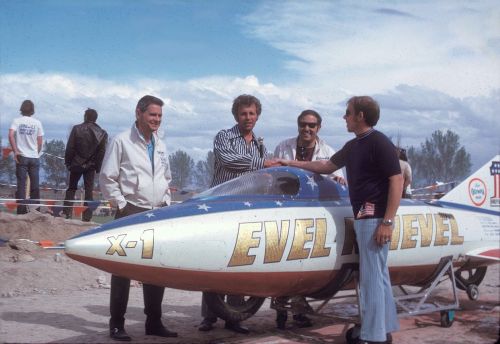
Doug Malewicki and Evel Knievel unveil Knievel's Steam Rocket Powered X-1 SkyCycle at the Twin Falls, Idaho, Snake River canyon jump site on May 6, 1972.
Doug Malewicki was the designer and engineer of Evel's X-1 Skycycle and X-2 Skycycle, the rocket-powered motorcycle that was shot over the Snake River Canyon to test the viability of his Skycycle jump.
An aeronautical engineer by training, Malewicki spent much of his career working for American aeronautics and space companies: the Apollo program moon landing vehicles, the Stealth bomber, and Cessna aircraft including their first private jet airplane. He was a model rocket enthusiast, (one of those geeky kids in the corner of the park that people unfairly point at), becoming famous early in his career for the Malewicki Equations that predicted the altitude and coast time of a model rocket flight.
According to Malewicki's daughter, he was the inspiration for the original one eyed monster, called Mike on Peewee's Playhouse TV show, and later to become the inspiration for Mike Wazowski drawn by Ricky Nierva in Monsters, Inc.


Wednesday, May 1, 2013
Today in motorcycle history, May 2, 1973

John Dolphin dies at 67 in Whitchurch-on-Thames, Oxfordshire.
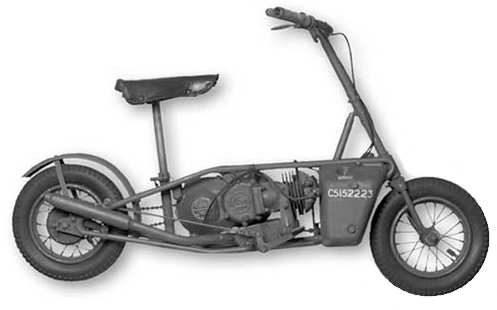
John Dolphin was the inventor the Welbike Parachutists' Motorcycle during his time as the Commanding Officer of the top secret Second World War Special Operations Executive (SOE) "Station IX" where specialist military equipment was developed. An engineer and natural-born inventor, Dolphin also invented the Welman and the Welfreighter midget submarines (the Welfreighter was classified Top Secret for over 50 years). All machines developed for the SOE by "Station IX" at Welwyn were given prefix "Wel-".
Being a motorcycle nut himself, (he owned a 1000cc Ariel Square Four), and with design help from Harry Lester, a former racing bike engineer, they developed a prototype of a small folding motorbike that could be dropped in a parachute container and be used by paratroopers. Codenamed the "Welbike" this was to be the first operational transport for individual parachutists. Between 1942 and 1945, 3853 were built and although it was not much used by the SOE, many were issued to the Parachute Regiment and used at Arnhem (Netherlands) during Operation Market Garden.
After leaving the British Army he founded a number of companies, including the Corgi Motorcycle Co Ltd. in 1946 and also set up Dolphin Industrial Developments Ltd, and Hydraulic Developments Ltd, which he ran until 1950 when he became Chief Engineer at the Atomic Weapons Research Establishment. He then went on to become Engineer-in-Chief at the United Kingdom Atomic Energy Authority Research Group until 1959. Not good at sitting still, he became joint Managing Director of Lansing Bagnall Ltd and J. E. Shay Ltd until 1964, and a Director of TI (Group Services) Ltd, where he successfully secured patents for a number of inventions, including sheet piling revetments, improvements to fork lift trucks and battery-powered tricycles (the forerunner of the modern mobility scooter), bicycle frames and exercise equipment.
John Robert Vernon Dolphin was appointed Commander of the Order of the British Empire (CBE) in the 1956 Queen's Birthday Honours.

Today in motorcycle history, May 1, 1976
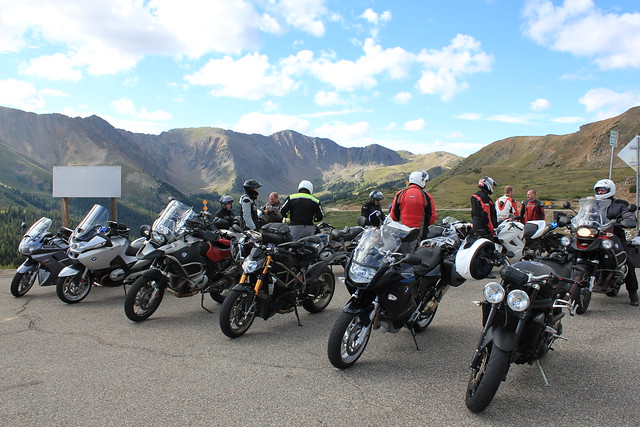
The BMW Motorcycle Club of Colorado is organized May 1, 1976 as MOA (Motorcycle Owners of America) Chartered Club #66.
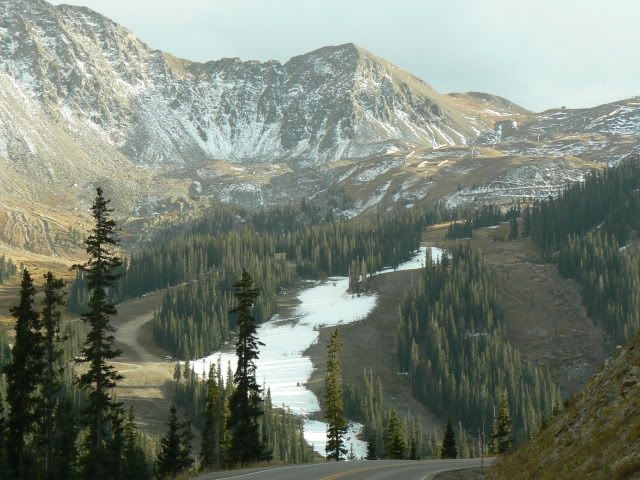
In addition to hosting the world renowned Top O' The Rockies Rally in Paonia, Colorado for the past 20+ years, they are also host to the annual 100,000 Foot Ride that takes riders on some of the most spectacular roads in America.
The Top O' The Rockies Rally is the club's annual rally located on the grounds of the City Park in historic Paonia on the Western Slope of the Rockies. The Top O’ The Rockies Rally started with the idea of providing riders with the best riding and scenery in Colorado.
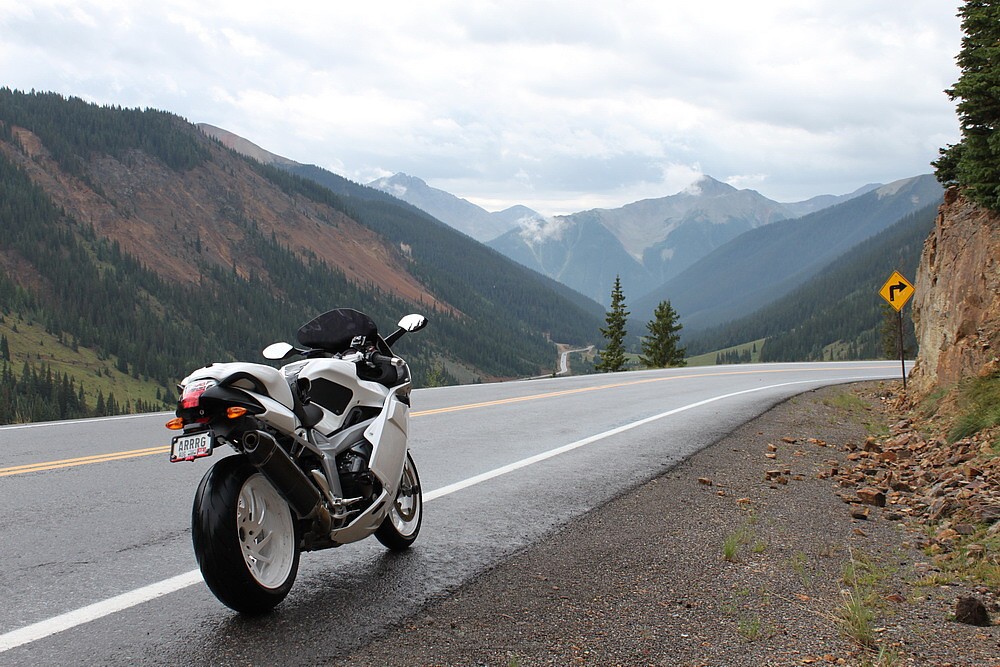
The BMWMCC also presents an annual all-day riding event, the 100K Foot Ride. The ride is structured to take you over enough mountain passes to total over 100,000 feet in a single day. This achievement is not attainable anywhere else in North America. The 100,000 Foot Ride provides riders with not only incredible views, but a broad selection of some of the best motorcycle roads the state has to offer.

Tuesday, April 30, 2013
Today in motorcycle history, April 30, 2004

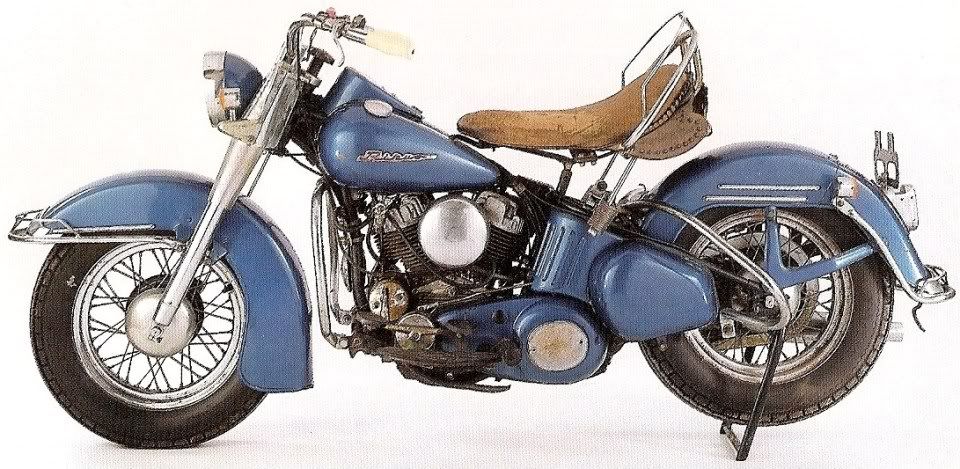
The American Motorcycle Museum opens with a collection of over 140 motorcycles.
Most of the bikes are Harley-Davidson and Indians, but the collection also includes motorcycles from Ace, Excelsior, Henderson, Reading Standard, Thor, Super X and a rarely seen, little known Rikuo (1930's Japanese Harley-Davidson).
Shortly after museum proprietor Max Middelbosch and his wife Ans bought their first Harley-Davidson, a 1980 Electra Glide, Max became an antiques dealer resulting in extensive travelling. Which in turn resulted in a fast growing motorcycle collection. Soon Max and Ans had visitors from all over the world showing up to take a look at their the home-basement motorcycle collection.
Realizing that they were in need of a little more space (not to mention a little more privacy), in 1988 they decided to restore their 1434 farmhouse (and yes, 1434 is a year not an address!) next to their company ‘De Drakentoren’, to house the collection. This interesting thing about this American Motorcycle Museum is it is in the town of Raalte, the Netherlands.
Raalte is approximately 58 miles east of Amsterdam, almost in a straightline. Everyone here recommends that the next time you're heading to Amsterdam take a little time out and go see this museum. Don't worry, Bulldog will still be open when you get back.

Subscribe to:
Posts (Atom)