Friday, December 26, 2014

Today in motorcycle history, December 26, 1965


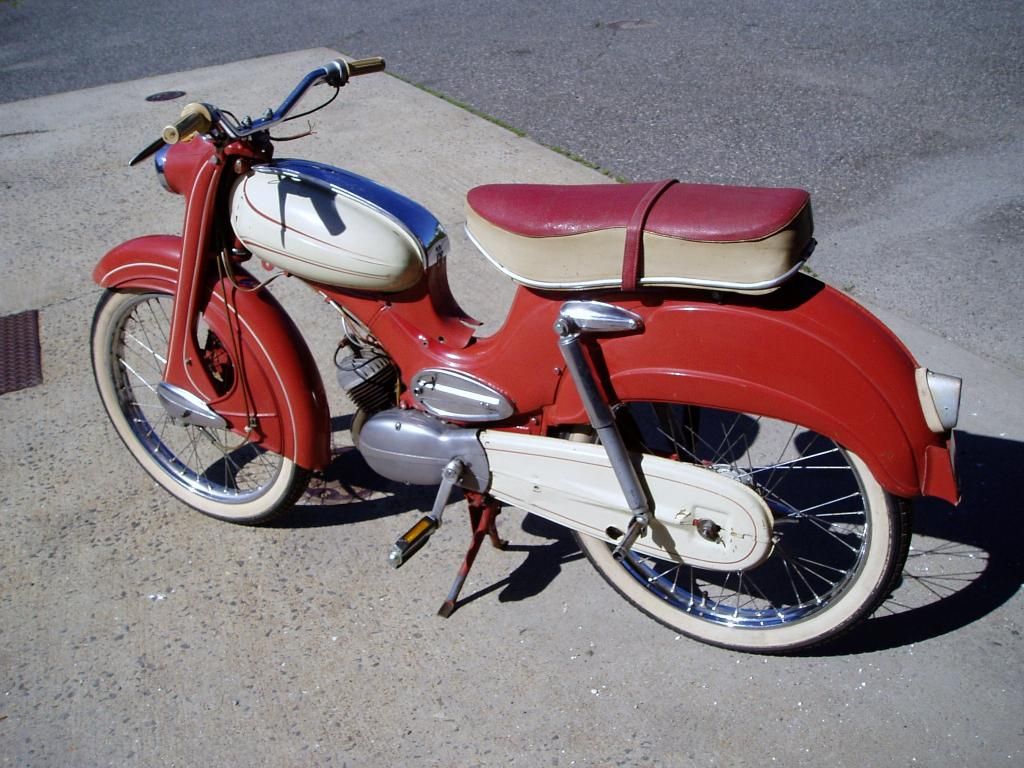
  Paul McCartney falls from his moped and chips his front tooth.  He would also get a nasty cut on his lip and be left with a scar from the accident.


  Also on the night time ride was McCartney's friend, Tara Browne, the Guinness heir whose death later inspired John Lennon to write the opening lines of "A Day In The Life".


  "I had an accident when I came off a moped in Wirral, near Liverpool. I had a very good friend who lived in London called Tara Browne, a Guinness heir - a nice Irish guy, very sensitive bloke. I'd see him from time to time, and enjoyed being around him. He came up to visit me in Liverpool once when I was there seeing my dad and brother. I had a couple of mopeds on hire, so we hit upon the bright idea of going to my cousin Bett's house.

  We were riding along on the mopeds. I was showing Tara the scenery. He was behind me, and it was an incredible full moon; it really was huge. I said something about the moon and he said 'yeah', and I suddenly had a freeze-frame image of myself at that angle to the ground when it's too late to pull back up again: I was still looking at the moon and then I looked at the ground, and it seemed to take a few minutes to think, 'Ah, too bad - I'm going to smack that pavement with my face!' Bang!

  There I was, chipped tooth and all. it came through my lip and split it. But I got up and we went along to my cousin's house. When I said, 'Don't worry, Bett, but I've had a bit of an accident,' she thought I was joking. She creased up laughing at first, but then she went 'Holy...!' I'd really given my face a good old smack; it looked like I'd been in the ring with Tyson for a few rounds. So she rang a friend of hers who was a doctor.

  He came round on the spot, took a needle out and, after great difficulty threading it, put it in the first half of the wound. He was shaking a bit, but got it all the way through, and then he said, ''Oh, the thread's just come out - I'll have to do it again!' No anaesthetic. I was standing there while he rethreaded it and pulled it through again.

  In fact that was why I started to grow a moustache. It was pretty embarrassing, because around that time you knew your pictures would get winged off to teeny-boppery magazines like 16, and it was pretty difficult to have a new picture taken with a big fat lip. So I started to grow a moustache - a sort of Sancho Panza - mainly to cover where my lip had been sewn.

  It caught on with the guys in the group: if one of us did something like growing his hair long and we liked the idea, we'd all tend to do it. And then it became seen as a kind of revolutionary idea, that young men of our age definitely ought to grow a moustache! And it all fell in with the Sgt Pepper thing, because he had a droopy moustache."

  Paul McCartney
  Anthology


  McCartney's chipped tooth and scar can plainly be seen in the promo videos for "Rain" and "Paperback Writer", which were filmed in London in May of 1966.


  Today in motorcycle history proudly supports the National Association for Bikers with a Disability (NABD). www.nabd.org.uk

Tuesday, December 23, 2014

Today in motorcycle history, December 24, 1999


  I came across this tidbit in the St. Petersburg Times (St. Petersburg, Florida), published December 24, 1999. 


  NEW PORT RICHEY -- An auto crash left a Pasco motorcycle deputy with a badly broken leg Thursday, the third accident involving the Sheriff's Office's "newly minted motorcycle unit" in the last three months.


  Riding his 1999 Honda Police bike, Deputy Ted J. Clegg, 44, was trying to overtake a traffic violator about 11:20 a.m. when a Chevrolet turned into the deputy's path on State Road 54 at Madison Street, according to the Florida Highway Patrol. The deputy's motorcycle struck the car, flipped over and skidded to a stop, the FHP said.


  Clegg's right leg was broken in three places, but he suffered no other injuries and was conscious at the scene, said Pasco County Fire-Rescue District Chief Doug Drape. Clegg was flown to Bayfront Medical Center in St. Petersburg, where he underwent surgery Thursday afternoon but appeared to be in stable condition, said sheriff's spokesman Jon Powers.


  The FHP is investigating the accident. The Chevrolet's driver, Jamie L. Olney, 26, of New Port Richey, was not hurt. No charges have been filed.


  With Thursday's crash, all three of the sheriff's motorcycles have been in accidents since the motorcycle squad began work in June, Power said.


  Perhaps some "newly minted motorcycle training" would have helped.


  Today in motorcycle history proudly supports the National Association for Bikers with a Disability (NABD). www.nabd.org.uk

Today in motorcycle history, December 23, 2007


    Evel Knievel vs Richard Hammond: The BBC Christmas Special.


  Shortly before his death, Evel Knievel was saluted by 'Top Gear' presenter Richard Hammond in a BBC2 Christmas special. The 60-minute television program "Richard Hammond Meets Evel Knievel" aired on December 23, 2007, less than a month after Evel died.


  The show was filmed in July 2007 around the annual "Evel Knievel Days" festival in his old home town of Butte, Montana. Knievel was clearly in severely declining health, but he still displayed the same piss and vinegar that he had his entire career.


  Today in motorcycle history proudly supports the National Association for Bikers with a Disability (NABD). www.nabd.org.uk

Monday, December 22, 2014

Today in motorcycle history, December 22, 1942


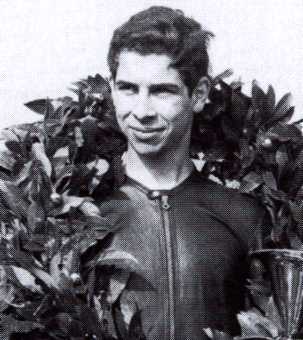
Former Catalan Grand Prix motorcycle racer Ramon Torres is born in Barcelona, Spain. 


  Born Ramon Torras Figueras in Barcelona, Spain. Ramon began racing at 16 on a 50cc Ducson in local motocross events. At eighteen, he was spotted by Senor Bulto of the famous Spanish Bultaco company and soon became a works rider. In 1962 he became a double Spanish Champion in the 125cc and 250cc classes.

  In preparation for the 1965 Isle of Man TT, Torras was riding in a minor street race circuit in Comar-Ruga. Aboard his 125cc Bultaco, with only 600 meters to go on the final lap, he skidded off the track and struck a tree. He was taken to a local emergency room, but they soon realized his condition was too serious for their facilities. Tragically, as he was being transferred to another clinic in Tarragona, he died from his injuries.


  Today in motorcycle history proudly supports the National Association for Bikers with a Disability (NABD). www.nabd.org.uk

Friday, December 19, 2014

Today in motorcycle history, December 19, 1918


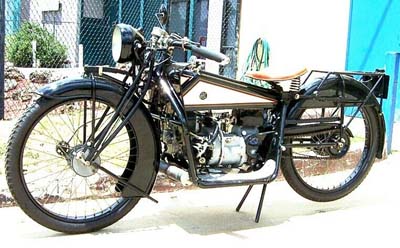
  An article entitled, "The ABC Motor Cycle. A New Development", written by Alvin Higgins, appears in 'Motor Cycle' magazine's December 19th, 1918 issue.


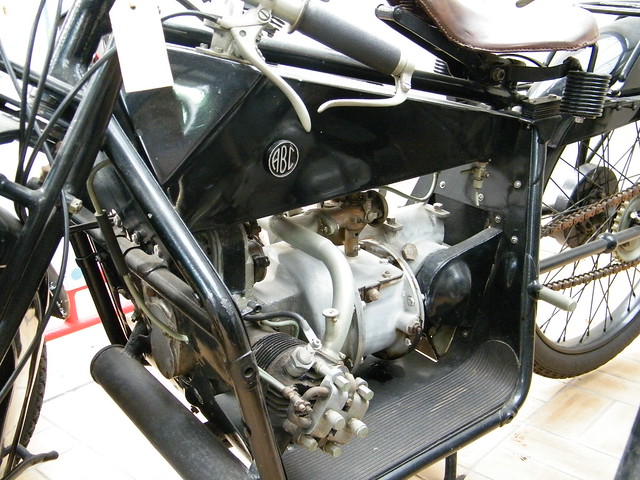
   Produced between 1919 and 1925, the ABC 400 had a 398cc horizontally opposed flat twin-cylinder overhead-valve four-stroke motor* with a four-speed tranny. Fitted with Claudel-Hobsob carburetor, it was capable of a top speed of over 70 mph.


  Founded in 1912 by Ronald 'Ronnie' Charteris, it was originally called Tthe All British Engine Company Ltd. of London. The company changed it's name to ABC Motors LTD. in 1914, then along with his friend and chief engineer Granville Bradshaw, they built a wide-range of engines throughout the First World War.


  ABC had always had a close association with the Sopwith aircraft company, which included producing the famous Sopwith Camel.  In December, 1918, ABC transferred the rights for manufacturing and selling motorcycles to Sopwith Aviation Co. Ltd. This would allow Bradshaw to focus on his designs. In 1919 they co-exhibited the Sopwith 390cc horizontally opposed twin-cylinder overhead valve  machine at the annual 'Motor Cycle' show. It was the talk of the show with it's innovative front and rear leaf springs and "expanding" brakes, wet sump lubrication and a four-speed transmission. It was also one of the first motorcycles with a duplex cradle frame. Curiously, it had no starting mechanism (hello, Granville?!), the rider actually had to jump start the engine to get going. The ABC 400 was made under license by the Sopwith Aviation & Engineering Co. in Kingston-upon-Thames and 2,200 were produced. Later models had improved valve gear, speedometers, and electric lighting. And a kick-starter. 


  The shift from producing aircraft to making motorcycles was more difficult than ABC expected and they ceased producing motorcycles after 1923.


*Several years later BMW adapted the design. Bradshaw challenged BMW's use of his patented design in 1926.


  Today in motorcycle history proudly supports the National Association for Bikers with a Disability (NABD). www.nabd.org.uk

Wednesday, December 17, 2014

Today in motorcycle history, December 17, 1970


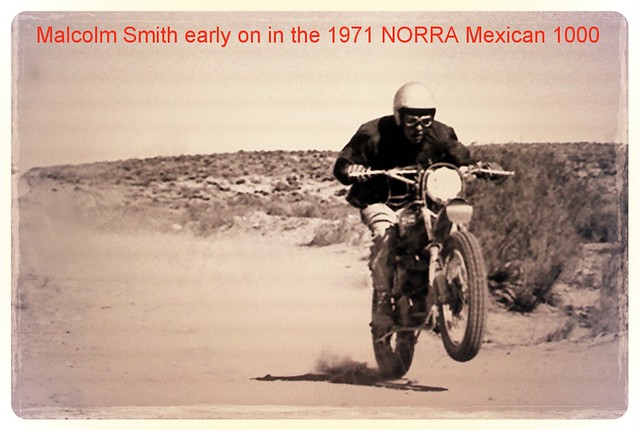
  A special factory built Husqvarna 395cc, 8-Speed engine is shipped to one, Malcolm Smith.


  The story goes, that one afternoon in 1965, Malcolm Smith was working in a shop in San Bernardino, California, owned by Rush "Pappy" Mott, when a gentleman came in and asked to talk to Malcolm. That man was Edison Dye. He was importing a kinda odd-looking, Swedish-made motorcycle called Husqvarna and he wanted him to race the bike. At the time Malcolm had a "sponsored" ride with Greeves and was reluctant to accept Dye’s proposal. But, two things changed his mind, one: after riding the Husky he was blown away by it's supreme power and handling and two: Edison Dye promised to pay Smith’s way to participate in the International Six Day Trials (ISTD), something Smith had been dreaming about for years (haven't we all?!).


  Smith was successful on the Husqvarna from the getgo, so much so that his name would become synonymous with the Swedish manufacturer.


  In 1966, Smith participated in his first Six Days in Sweden. Being strictly a Southern California rider up to that time, Smith had never ridden in the conditions that awaited him in Sweden, complete with mud, rocks and roots. He crashed what felt like a hundred times and nearly damaged his bike beyond repair. But he persevered and earned a silver medal.


  The next year the ISDT was in Poland where Malcolm would earn his first gold medal, something he would do seven more times during his racing career, making him the most successful American rider in the history of the Six Days competition to that point.


  Today in motorcycle history proudly supports the National Association for Bikers with a Disability (NABD). www.nabd.org.uk
Tuesday, December 16, 2014

Today in motorcycle history, December 16, 1955


  It's a solemn day in Stevenage as the last Vincent Black Prince rolls off the assembly line.


  The Black Prince was described by Phillip Vincent as a “two-wheeled Bentley”. One of two Series D models designed to revitalize the brand's styling, the nearly fully enclosed Black Prince featured a number of design changes, not least of all, the innovative enclosure offering weather/road grime protection to the discerning rider, allowing them to wear proper business attire rather than those cumbersome riding leathers. Another feature was the center-stand, which could be foot-operated from the rider's seated position, making it easier to dismount.


  The Black Prince was launched at the 1954 Earls Court motorcycle show, together with the 998cc Vincent Black Knight and the 500cc Vincent Victor (which never went into production as only the prototype was ever built). There was a lot of interest but much of it was critical, and the Black Prince was termed the motorcycle you either love or hate. "The Motor Cycle" road tested a Prince and concluded that it handled as well as the Black Shadow, but with better gas mileage.


  Failing to generate the sales they had hoped for, the Series D models would prove to be Vincent's swan song and the last Black Prince rolled off the assembly line on December 16, 1955. Only 120 were produced.


  Today in motorcycle history proudly supports the National Association for Bikers with a Disability (NABD). www.nabd.org.uk