Wednesday, December 10, 2014

Today in motorcycle history, December 10, 1967


 in-house-lizard-020.jpg  in-house-lizard-052.jpg  in-house-lizard-085.jpg

  Jim Morrison is arrested during a concert at New Haven, Connecticut. While Jim was backstage with a girl, a cop, not realizing who he was, told the couple to leave. Jim resisted and was maced by the cop. During the show, he began to recount the story about “the little blue man, in the little blue cap”. The police got pissed-off, stopped the show and arrested Morrison.


  Brian Hubbs', owner of Big Pimpin’ Cycles in Schenectady, New York, recent project, a 1983 Honda CB650SC Nighthawk he calls the“Lizard King” pays homage to the late Doors frontman.

  Not running and destined to be used as a boat anchor, Brian paid $250 for the Nighthawk.  After borrowing his friend and his pick-up, Hubbs cracked a beer, put on a Doors CD and grabbed a wrench. He then stripped the bike, fitted his own hardtail, re-ported the engine, polished the head, added a 6Sigma Jet Kit and new Accel ignition coils. He then fit it with custom-bent "double-barrel shotgun" exhaust pipes. 

  Hubbs designed  the stainless-steel seat and did his signature one-off leather work. He also did the leather wrapping on the speedometer and reservoir covers as well. One of the only pieces to be ordered were the Deadhorse Custom Leather handgrips. They hand-tooled “Mojo” on the left and “Rising” on the right, adding another tribute to Morrison.


  The modified Sportster tank and fender were painted Rootbeer Candy over silver nugget base with 24k gold flake and lime accents. Then he covered it all in House of Kolor Urethane Show Klear.
   A Colt .45 hollow point shifter peg and custom taillight made from a surplus hand grenade sum up the attitude of this "fuck you" bike.


  German custom bike builder Dirk Metzer, owner of  Dime Design Custom Cycles in Monchengladbach, Germany, was commissioned to start planning and fabricating a Jim Morrison-themed bike by long time Doors fan and author Jochen Maaben.


  This Jim Morrison tribute bike began life as a Suzuki Intruder. Everything was shit-canned except the 1400cc motor.  The Intruder mill was fit into an AME "old skool" frame,  using a Harley 21" front wheel and an AME 16" rear wheel. The handle bars, stretched tank, air filter, and fender were all custom designed by DIME. Pouring over old bike magazines, Maaben and Metzer tried to keep as close to the sixties chopper-style as they could. 

  The two added numerous Doors references all over the bike, like "Blue Lady", "Strange Days", "Break On Through", "The End", "Mr. Mojo Risin'", Jim's signature and, of course, Jim's airbrushed portrait on the tank.


  The coup de grace was the brake light in the sissy bar. It's a "king snake" with red LED eyes.


  Due to piracy laws I am not able to show you the DIME bike.  Arrr!


  Today in motorcycle history proudly supports the National Association for Bikers with a Disability (NABD). www.nabd.org.uk


Tuesday, December 9, 2014

Today in motorcycle history, December 9, 1902


  Gladiator Cycle Company introduces it's first motorcycle. 


  Gladiator Cycle Company, a French bicycle manufacturer, was founded by Alexandre Darracq and Paul Aucoq in 1891 at Le PrĂ©-Saint-Gervais in northeast Paris.  Adolphe Clement, owner of rival Clement Cycles, was a large investor.


  In 1895 Gladiator introduced its first internal combustion engine, a naphtha powered tricycle.


  After numerous, and at times nearly fatal, failed attempts, in 1902 they finally offered a motorized bicycle with a 142cc engine bolted to the frame. The motor used overhead valves and a detachable cylinder head; the inlet valve was automatically controlled by the engines suction, the exhaust valve was mechanically operated. A coil-and-battery ignition was used, and a two-barrel carb was controlled by small levers attached to the frames top tube. An external flywheel kept the crankcase very small, and a long belt from the engine pulley to a rim on the rear wheel was tensioned by a small pulley on the seat tube. The front brake pressed direct on the front tire, the rear was a coaster brake activated by back-pedaling. 


  The bike was sold under both the Gladiator and Clement marques.


  Today in motorcycle history proudly supports the National Association for Bikers with a Disability (NABD). www.nabd.org.uk

Monday, December 8, 2014

Today in motorcycle history, December 8, 1972


  Australian Speedway 'Legend' Jack Biggs is killed when he crashes his 500cc JAP machine on Bendigo's (Victoria) Golden City Speedway.  It was the same bike he'd been racing for twenty-four years.


  Today in motorcycle history proudly supports the National Association for Bikers with a Disability (NABD). www.nabd.org.uk

Friday, December 5, 2014

Today in motorcycle history, December 5, 1951


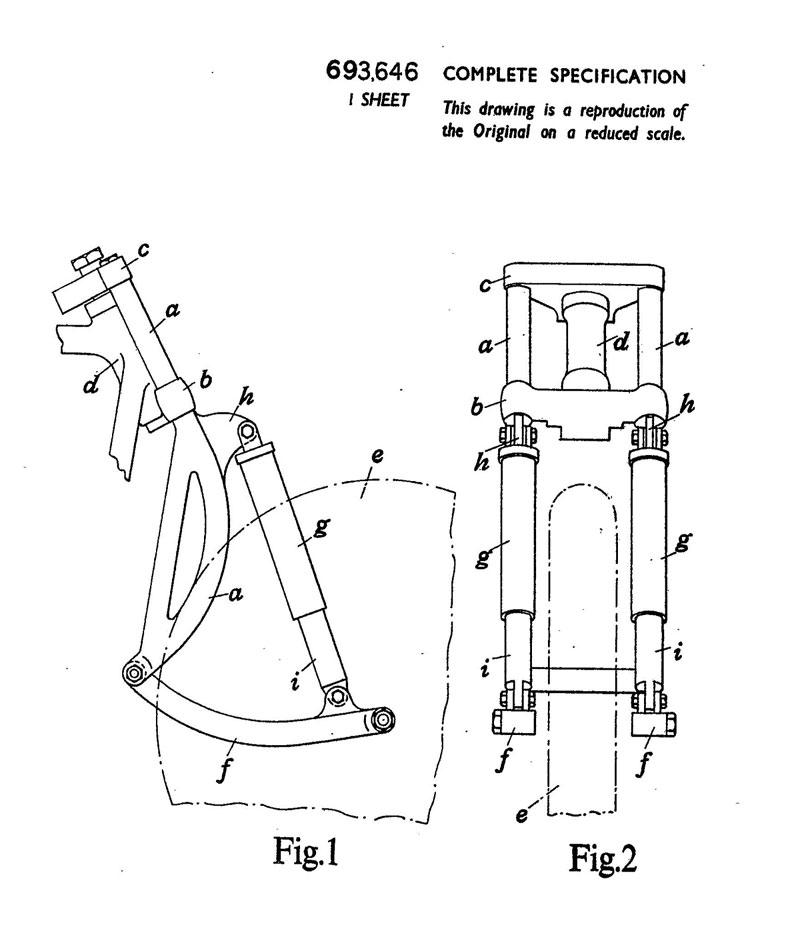
  Ernest Richard George Earles applies for a patent for his leading link fork.  Filed under "Motor Cycle Front Wheel Forks", the Earles Fork is born. 


  The Earles fork was a variety of leading link fork where the pivot point was aft of the rear of the front wheel — this was the basis of a patent for the design.  This triangulated fork actually caused the front end of a motorcycle to rise when braking hard — the reverse of the action of a telescopic fork.


 Possibly the greatest benefit of the Earles fork in sidecar use was its adjustability for rake and trail. The swinging arm pivot had two positions. Moving it to the forward position reduced trail, allowing the bike to turn with less effort when a sidecar was attached.


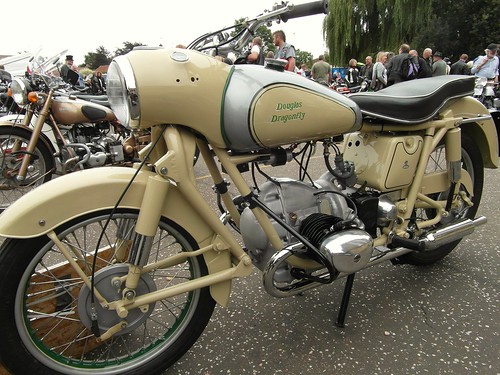
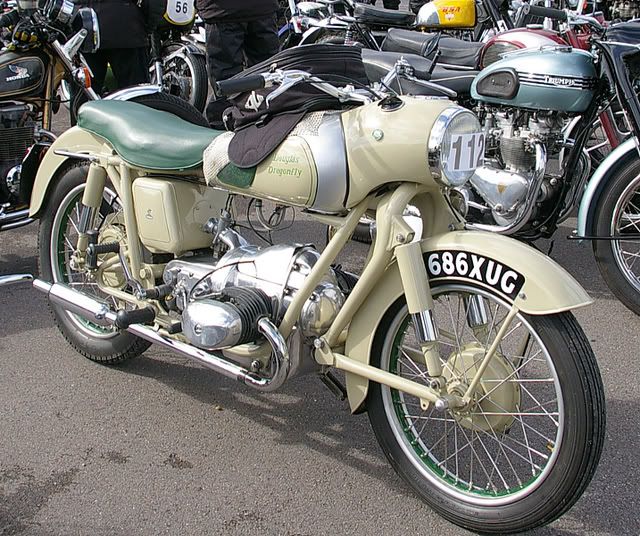
  Several motorcycle manufacturers licensed the Earles patent forks for racing motorcycles in 1953, such as MV Agusta and BMW, while other companies such as Douglas used the Earles design on their roadsters or off-road machines. BMW is best known for their use of Earles forks, as from 1955 to 1969 they were featured on every BMW motorcycle.


  Today in motorcycle history proudly supports the National Association for Bikers with a Disability (NABD). www.nabd.org.uk

Thursday, December 4, 2014

Today in motorcycle history, December 4, 2006


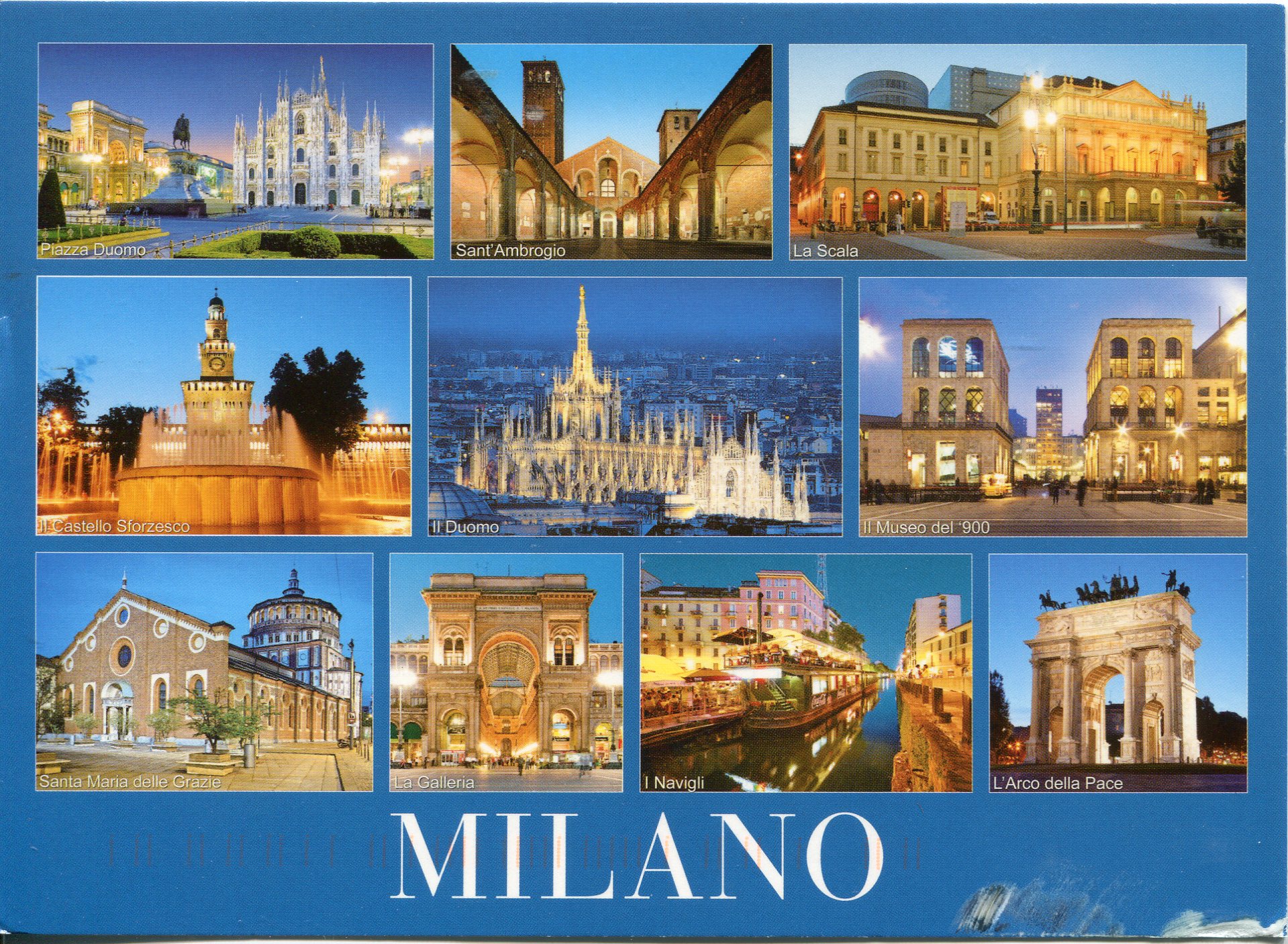
  Aprilia Vice President Leo Mercanti had a shit-eating grin on his face as he showed a number of their new bikes and products at the 64th EICMA International Milan Motorbike Show (EICMA 2006).


  The '06 Milan Aprilia exhibit was highlighted by four completely new products: an automatic transmission unit called the 850 Mana, a new mid-size entry called the SL 750 Shiver, a new motocrosser dubbed the “MXV”, and a four-cylinder, 200hp engine capable of powering the brand in future MotoGP competition.


  The Mana 850 is powered by a 90-degree V-twin engine delivering 75 hp at 7250 rpm. However, the focal point of the innovative bike was without a doubt the electronically controlled seven-speed sequential transmission that allowed a rider to switch from automatic mode to sequential mode at any time and in any riding condition.

  In automatic mode, everything is controlled electronically. The CVT transmission enables the engine to be run at maximum torque at all times, emphasizing pick-up and acceleration. The electronic control system has three different mappings — Touring, Sport and Rain — enabling the rider to choose the type of operation most appropriate to the situation.

  In Sequential mode, the rider would choose the gear by means of either the control on the handlebars or a pedal command. A servo-assisted mechanism acts mechanically on the main pulley, making changing between the seven ratios extremely rapid.


  The SL 750 Shiver also contains some unique traits, including “ride by wire” electronic management of the accelerator.

  The “ride-by-wire” engine management unit controls all engine parameters. All data passes through a CAN (Controlled Area Network) line to the instrument panel, which also acts as a diagnostic terminal. The CAN line uses just two wires to transmit all data.

  Powered by Aprilia’s new 90-degree V2 engine producing 95hp, the 416-pound Shiver is further outfitted with a 43 mm upside down fork, lay-down shock absorber resting directly on the swingarm, and the biconical aluminium handlebars from the Tuono. Stopping power comes from braided brake lines hooked to radial-mounted calipers using the same 320 mm front disks mounted on the the RSV 1000 and Tuono 1000 R.


  The next new Aprilia product that was shown, the MXV 450, it was the third bike in the company’s “V” range, joining the enduro RXV and supermoto SXV.


  Finally, Aprilia’s new 999cc, 65-degree V4 engine produces more than 210bhp at 13.500rpm. The company says it will start testing the engine in a brand new chassis this spring, and plans on the first finished version to be at next year’s EICMA show for a 2008 attack on the World Superbike crown.


  Geez, my pan has a kickstart, a four-speed and an ignition switch wired backwards that I was too lazy to change.


  Today in motorcycle history proudly supports the National Association for Bikers with a Disability (NABD). www.nabd.org.uk

Tuesday, December 2, 2014

Today in motorcycle history, December 3, 1920


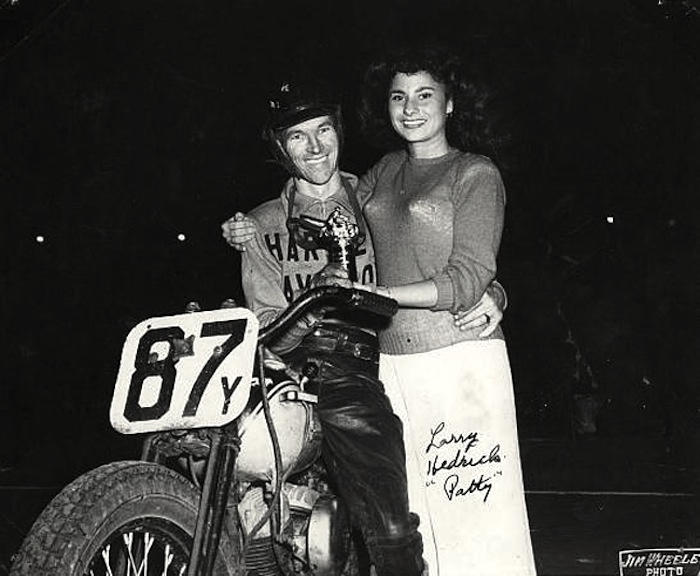
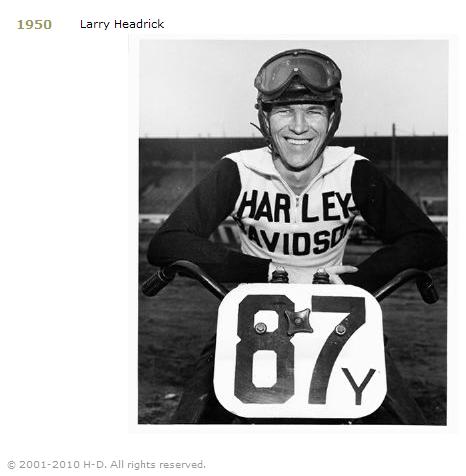
  1950 AMA Grand National Champion and AMA Hall of Famer, Larry Headrick is born in Wichita, Kansas.


  Larry Headrick had a brief, but spectacular racing career. In 1950, he rode a Tom Sifton-prepared Harley-Davidson to three AMA National wins on mile dirt ovals, including earning the National Championship at Springfield, Illinois. Larry's upset victory at Springfield that year was one of the most surprising in the history of the race.


  Despite his victory at Bay Meadows two months earlier, Larry Headrick was still a long shot at winning the coveted number one plate. At Springfield Paul Goldsmith took the early lead in the 25-mile final on a factory Harley with Larry close behind. At one point, Headrick said that Goldsmith tried to shake him off by intentionally pelting him with a thick roostertail. Then Goldsmith's bike broke an axle and Headrick found himself in the lead. He faced one more challenge when (the legendary) Bobby Hill came past and put his Indian into the lead. Late in the race, Hill's bike began to slow and Headrick slipped by to earn the win and with it the 1950 AMA National Championship.


  Headrick became the first West Coast rider to win the Springfield Mile.


  A week later, he proved his Springfield Mile win was no fluke when he came out on top again at the Milwaukee Mile. Headrick had practically come out of nowhere to win three of the biggest races of the year. It is one of the great stories of "overnight success" in AMA racing history.


  Sadly, Larry Headrick's career was cut short at the end of the 1950 season when he was hit by a car while riding his motorcycle on the street. The accident shattered his left leg, making it impossible for him to race again on the dirt-track ovals.  At 30, with a bum leg and four rug-rats to feed, Headrick decided to give up racing. 


  Larry Headrick was inducted in the AMA Hall of Fame in 1998.


  Today in motorcycle history proudly supports the National Association for Bikers with a Disability (NABD). www.nabd.org.uk

Monday, December 1, 2014

Today in motorcycle history, December 2, 1964


  The Research & Development team at Suzuki has it's sights set on the perfect 125cc.


   Honda had a new four-cylinder developed known as the RC 146. Suzuki then assumed that two cylinders would not be enough to win with in the future. Immediately following the 1963 Japanese Grand Prix Suzuki began the development of a square-four, water cooled engine, internally called RK64. But the development of the machine wasn't finished until the season was already over. The completed engine design was turned in on December 2, 1964 and first engines would hopefully be built in February of 1965.

  Then the development team changed the name to RS 65. The bike still some technical difficulties, including sky-high oil temperatures. After a month of frustration it was decided to start with a new direction, the three-cylinder RJ 66 , which one would start in November of 1965. The old racer, the water-cooled two-cylinder, was now called the RT 65. Confused yet?


  1963, '64 and '65 Japanese 125cc GP's had Suzuki feeling like it could keep the title forever. There appeared only one cloud on the horizon: Yamaha had a water-cooled version of the RA 97 made.


  Today in motorcycle history proudly supports the National Association for Bikers with a Disability (NABD). www.nabd.org.uk