Friday, May 15, 2015

Today in motorcycle history, May 15, 2007


  The first woman solo rider to ride the Isle of Man TT, Beryl Swain, dies at 71.


  It all started when Beryl Tolman fell for Eddie Swain, a mechanic and owner of a motorcycle repair shop in London. They married in 1952 and entered the realm of motorcycle racing with Beryl twisting the throttle.


  Soon she’d find her niche in the 50cc class. Cutting her teeth competing at tracks such as Brands Hatch and Snetterton, then in 1962 she became the first woman solo rider to ride the Isle of Man TT course in an official event. Riding her Italian Itom 50cc she conquered the hair-raising circuit coming in 22nd in a field of 25.   

  Swain was hooked. 

  Shortly after crossing the finishing line she announced her plans to return the following year. Her announced plans to return the next year would seal her fate.

  In an embarrassingly chauvinistic move, the FIM (the governing body) decided upon Beryl’s announcement to return to the TT to revoke her international racing license. The reason?  It was reported that the FIM didn’t want to risk an outcome of a female dying on the dangerous circuit.


  Or did they bristle at the thought of a woman achieving any success over men? Was it a backward show of concern that fans or the Press would react more negatively to a woman having an accident at the famous road course? Either way, the controversy was brought to the forefront. But, change was still slow in coming, as it wasn't until 1978 when Hilary Musson became the next woman to compete as a solo rider at the TT.


  Beryl never returned to racing after her license was revoked. She worked as a manager in the London area for Sainsbury’s, a chain of  supermarkets in the UK.


  Beryl Swain would leave a legacy that still stirs the hearts of many woman racers.


  Today in motorcycle history proudly supports the National Association for Bikers with a Disability (NABD). www.nabd.org.uk

Thursday, May 14, 2015

Today in motorcycle history, May 14, 1914


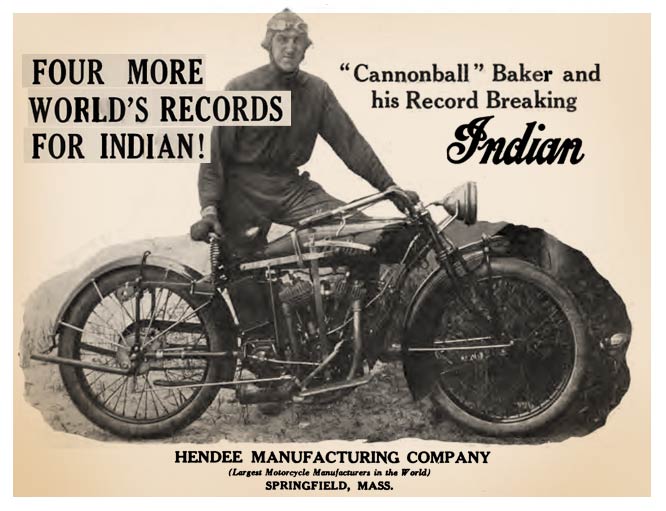
  Erwin George Baker rides his 2-speed, 7hp Indian into NYC to complete his famous transcontinental ride, San Diego, California to New York City in an astonishing time of eleven days. Nine days faster than the previous record! 


  A little history of E.B. "Cannonball" Baker - Baker purchased his first Indian in 1908 and right-off-the-bat began winning races. One of his most famous victory's came in 1909 at the first race ever held at the newly built Indianapolis Motor Speedway. From there it was on to endurance runs. A lot of his early records were city-to-city runs. These were in the days long before paved roads, shit, even a well-maintained road was a rarity. Baker often encountered axle-deep mud, sand washes, flooded river crossings and snowed-in mountain passes during his long-distance rides. 


  The following are partial excerpts from his own personal account (he kept a diary) of Day 1 - May 3, 1914 and Day 12 - May 14, 1914.


  Day 1, San Diego to Yuma, Arizona


  "...I started through Coyote Wells, which was a stretch of 15 miles knee-deep with sand, cactus, sage brush and mesquite bushes, which was nothing more than a trail to Imperial Valley. This point is 250 feet below sea level. Then I found good roads from the end of this sand stretch into Brawley and from there on I was riding silt, which was axle deep for 19 miles to Mammoth Wash. At this point I decided to do the camel act and go without drinking water. I picked up a small black pebble about the size of a dime and placed this in my mouth under my tongue—same as the desert Indians do—in order to keep from drinking water. About one quarter of the way onto New Mexico I decided I would have just one swallow of water, and after going a little bit further found I would have another one. By the time I reached the railroad track I decided on taking one more swallow of water, and one more only until I reached Yuma, Arizona, which was the stopping point for the night. However, had I not carried the little pebble in my mouth my stops for water would have been multiplied many times..."


  Day 12, Greensburg, Pennsylvania to New York City


  "On the morning of the 14th at 4 a.m., I started from Greensburg with the intention of making Philadelphia my next night’s stop. The roads began to look better to me, and I soon made up my mind that I would not stop until I had reached New York.

  I reached Philadelphia about 6 o’clock in the evening, or, rather, Paoli, which is 30 miles west of Philadelphia. There George S. Maslen, the Indian dealer at Philadelphia, met me with a number of riders and he elected one of them to show me the way into New York City. After having supper at Paoli, we started for New York City, and it being a very dark night, we were lost two or three times, even with the rider who knew the roads. He showed me the way to Weehawken, N.J., where I took the ferry to New York City.

  This ferry consumed over half an hour of my finishing time, and my feet touched the streets of New York at 10 minutes past 12, the night of the 14th. I landed at West Forty-second street.

  Pictures were taken by flashlight at the ferry house, and then I proceeded to the Hotel Astor, where I was met by a delegation of New York reporters and Associated Press men, also by Mr. Sherman, of the Publicity Department of the Hendee Manufacturing Company.

  My race with time was then ended and I found that I had accomplished that which I had undertaken; that my trip had taken only 11 days, 12 hours and 10 minutes.

  I took along an extra electric light bulb, expecting to need it in such hard riding. But I arrived in New York with the original bulb still in its socket and burning brightly. My batteries were still in fine condition and needed no recharging or attention during the ride.

  In my estimate it was the cradle spring frame above all else that contributed to my success. It absorbed all road shocks and vibrations, and this, of course, saved my strength and beside, enabled me to make speed over the roughest roads. Then after talking with the reporters until 2 o’clock in the morning, I turned in."


  After that record-setting transcontinental run a New York reporter compared him to the Cannonball Express (train) and the moniker stuck.


  "Cannonball" Baker made more than 143 attempts at a variety of long-distance records, including his most famous transcontinental and three flags (Canada to Mexico) attempts.


  Today in motorcycle history proudly supports the National Association for Bikers with a Disability (NABD). www.nabd.org.uk

Wednesday, May 13, 2015

Today in motorcycle history, May 13, 1973


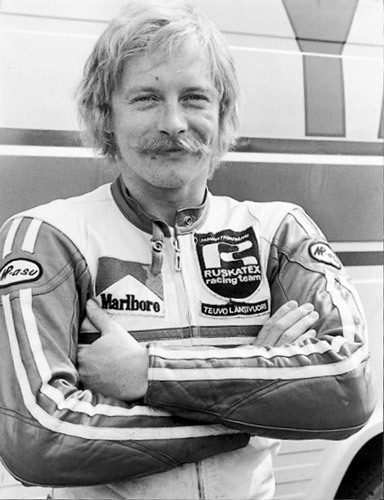
  Finland's Teuvo Länsivuori, riding a works Yamaha, wins the 250cc Class West German Grand Prix at Hockenheimring.


  The expression, "always a bridesmaid" certainly fit 'The Flying Fin' in 1973. Teuvo Pentti "Tepi" Länsivuori finished second in the 250cc World Championship to the crowd favorite, Germany's Dieter Braun and then, to rub salt in his wound, he rode to another second place finish behind the legend known as Giacomo Agostini in the 350cc World Championship.


  Three years later he would again finish second, this time to his Suzuki stable-mate, Britain's Barry Sheene, in the 500cc World Championship.


  Today in motorcycle history proudly supports the National Association for Bikers with a Disability (NABD). www.nabd.org.uk

Tuesday, May 12, 2015

Today in motorcycle history, May 12, 1961


  German sidecar racer Hilmar Cecco is killed during a non-Championship race in Modena, Italy.


  Hilmar Cecco began sidecar racing on German grasstrack circuits in 1954, teaming with fellow countryman, Fritz Mader.  For the '57 season he was offered to compete in International races with Switzerland's Edgar Strub. With no luck and itching for a win, 1958 would see Hilmar partner with the Swiss driver, Florian Camathias. Camathias and Cecco would stand on the podium with 2nd Place finishes in the 1958 and 1959 World Sidecar Championships. In 1960 Cecco would again team with Strub, but returned to Camathias for the '61 campaign. 


  On the final bend of a non-Championship race in Modena, Italy, Camathias' BMW ran wide and left the circuit causing it to somersault. They were rushed to the Policlinico Hospital where Hilmar Cecco died the following day from severe head injuries. 


  They had been leading the race and were on their 25th and last lap.


  Today in motorcycle history proudly supports the National Association for Bikers with a Disability (NABD). www.nabd.org.uk
Sunday, May 10, 2015

Today in motorcycle history, May 11, 1972


  A horse is a horse, of course, unless of course that horse is ........a Yamaha?


  Came across this bit of motorcycle history while reading The Superior Express newspaper "serving Superior, Nuckolls County, Nebraska", dated Thursday, May 11, 1972.


  "Motorcycles have replaced the faithful old horses on the Schuster farm south of Superior. Clare Schuster and his son Kenneth report that motorcycles are much more effective for rounding up cattle than horses and cycles come in handy for several other duties on the farm, as well.


  The most recent use is as portable weed sprayers.


  Clare has adopted a 20 pound Freon gas bottle and now uses it as a power sprayer. To further outfit the cycle a spade carrier has been added. The spade is used to remove nodding thistle and other noxious weeds in the pasture. They have worked cattle with 90cc Yamaha motorcycles for some years now and they are very enthusiastic about the efficiency and the bikes are never hard to catch and they never tire.


  According to Clare they have one disadvantage, they're hard to push when they run out of gas."


  The cattle were rounded up by two Yamaha 90cc bikes.


  Superior bills itself as the "Victorian Capital of Nebraska", and holds an annual Victorian Festival. The downtown area is listed in the National Register of Historic Places.


  Today in motorcycle history proudly supports the National Association for Bikers with a Disability (NABD). www.nabd.org.uk
Saturday, May 9, 2015

Today in motorcycle history, May 9, 1982


  Jean-François BaldĂ© wins the 350cc Class French Grand Prix.


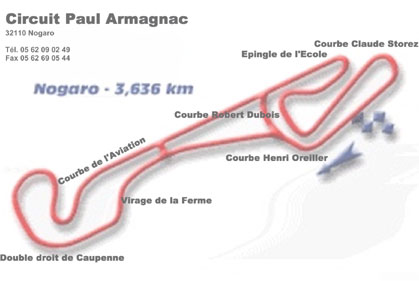
  In his final year racing for Kawasaki, Jean-François BaldĂ© wins the 350cc Class French Grand Prix at Circuit Paul Armagnac (named after the famous motorcycle ace of the fifties and sixties) near Nogaro in southwestern France.


  Jean-François BaldĂ© would be the last winner of the 350cc Class French Grand Prix. The 350 Class would not be included in the French GP in 1983, '84 and '85, it would be completely eliminated from Grand Prix racing in 1986.


  Nogaro is the site of a distillery of Armagnac brandy.


  Today in motorcycle history proudly supports the National Association for Bikers with a Disability (NABD). www.nabd.org.uk

Friday, May 8, 2015

Today in motorcycle history, May 8, 1973


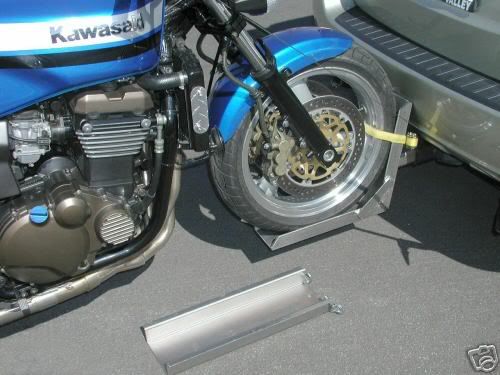
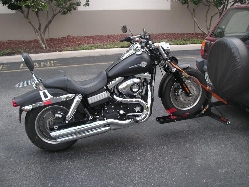
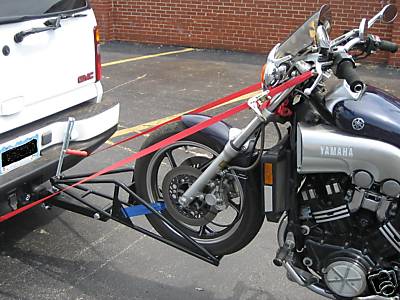
  Rafael Long applies for his motorcycle towbar patent - "Bike rack for camper and the like".  Patent US 3731830 A.


  Mr. Long's application summary reads, "A rack for receiving and supporting a motorbike and the like on the body of a road vehicle in a manner for shift-ability and angular swing relative thereto for enabling ingress and/or egress to and from the body of the vehicle without complete removal of the motor bike from the rack entailing a carrier longitudinally movable and balanceable relative to a hinged roller support, spaced from bridging means on the vehicle and including suitable locking means convertible to a ramp for use during unloading and loading of the motor bike relative to the rack."


  "Such prior known carriers usually include a channel member for supporting a two-wheeled cycle in a relatively fixed condition on the back end of a conventional automotive main vehicle. Each case entails the problem of loading and unloading the motor bike relative to the carrier and the securing of the motorbike onto such carriers. Such carriers are usually mounted on the rear bumper of the main vehicle which may be a passenger vehicle, a station wagon, a trailer, a pick-up truck having a tailgate or an open body for a detachable camper and the like. In all cases if it is desired to gain access to the main vehicle either through the rear trunk; the tailgate or the rear 'door of a trailer or camper body, the motorbike usually has to be removed from such prior known carriers. The present invention seeks to overcome such tedious problems by providing a carrier constructed to facilitate access to or ingress and/or egress from the after end of the main vehicle without removing the motorbike from its carrier."


  Of course, once Rafael is granted his patent every Joe Inventor thinks they know a better way.


  Today in motorcycle history proudly supports the National Association for Bikers with a Disability (NABD). www.nabd.org.uk