Friday, May 17, 2013

Today in motorcycle history, May 17, 1965


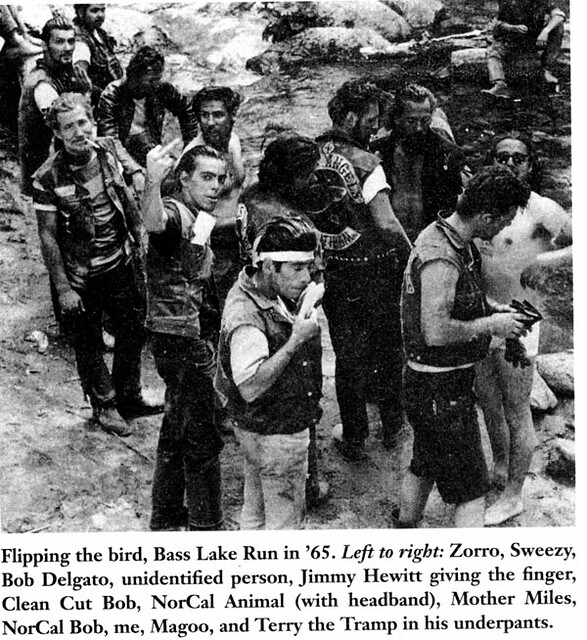
  Hell's Angels: The Strange and Terrible Saga of the Outlaw Motorcycle Gangs began as the article "The Motorcycle Gangs: Losers and Outsiders" for the May 17, 1965 issue of The Nation.


   In March 1965, The Nation editor Carey McWilliams wrote to Hunter S. Thompson and offered to pay the journalist for an article on the subject of motorcycle gangs, and the Hells Angels in particular. Thompson took the job and the article, published about a month later, prompted book offers from several publishers interested in the topic.

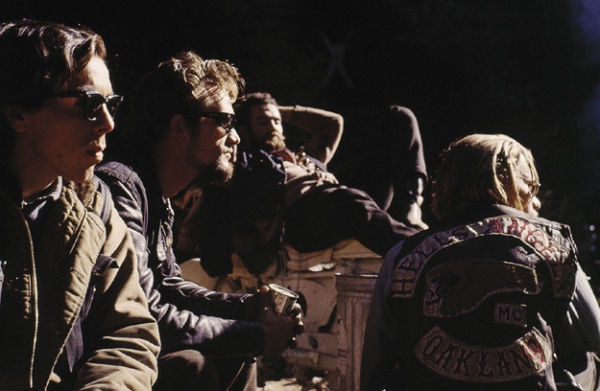
  Thompson spent the next year preparing for the new book in close quarters with the Hells Angels, in particular the San Francisco and Oakland chapters of the club and their president Ralph "Sonny" Barger.  Thompson was straight-up with the Angels about his role as a journalist, knowing their distrust of reporters for what the club considered to be bad press.  Thompson was introduced to the club by Birney Jarvis, a former patch-holder and then police-beat reporter for the San Francisco Chronicle.  This introduction, coming from an Angel and reporter, allowed Thompson to get close to the gang in a way others had not been able.


  Far from being wary of this outsider, the Angels were sincere in their participation, often talking at length over smokes, shots and beer into Thompson's tape recorder and reviewing early drafts of the article to ensure he had his facts straight.  During his writings the Angels often visited his apartment at 318 Parnassus Avenue in San Francisco, much to the dismay of his wife, landlord and neighbors.  Thompson, however, felt comfortable with the arrangement, so comfortable that when he was "jokingly" threatened with violence, he allegedly pointed to a loaded double-barrelled shotgun that he kept hanging on his wall and replied in a similar vein that he would "croak two of them first." 


Wednesday, May 15, 2013

Today in motorcycle history, May 15, 1949, 1982 and 2008


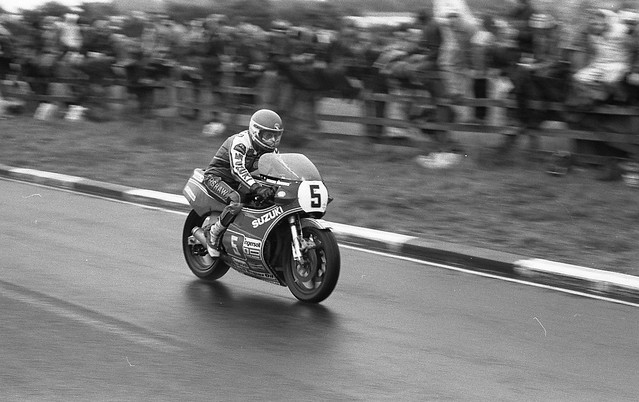
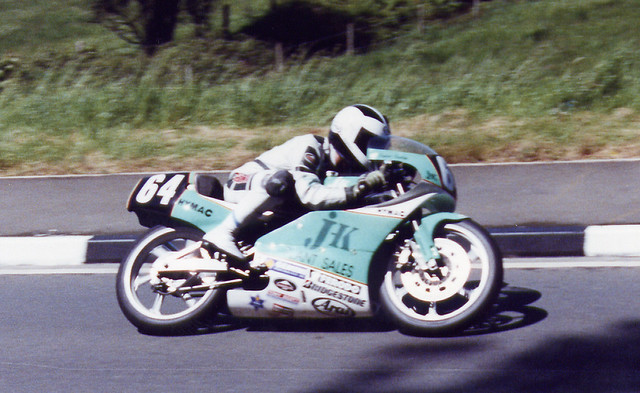
  The North West 200 claimed the lives of 3 riders on this day in motorcycle history.  Englishmen P.L. Phillips on May 15, 1949 at Portstewart and John Newbold in 1982 on Juniper Hill and Northern Ireland's Robert Dunlop was killed approaching Mather's Cross on this day in 2008.


  The North West 200 is held each May in Northern Ireland.  The course is a street circuit, made up of public roads running between the towns of Portstewart, Coleraine and Portrush (the Triangle) but does include three speed reducing chicanes.  The route, running anti-clockwise enters the outskirts of the towns passing many private homes, restaurants and pubs.  To help improve track safety street signs are removed at parts of the track and bales of hay are used to wrap the base of lampposts and telegraph poles.  I never quite understood removing street signs to improve track safety.  Hmm, "Caution: Road Ends", now that's a silly sign let's remove it.  Who's gonna notice.


 The original start/finish line was located near Magherabouy but moved to the Portmore Road in Portstewart in 1930.  Intended to be held somewhere in the north west of Ireland and organized by the City of Derry & District Motor Club, the initial event was moved to the north coast but the name was never changed and since 1964 the event has been organized by the Coleraine and District Motor Club. 


  The race is one of the fastest in the world, with speeds in excess of 200 mph.  In practice for the 2012 event Martin Jessopp was clocked at 208 mph.  It is one of around fifteen events run on public roads between April and October throughout the island of Ireland.

Tuesday, May 14, 2013

Today in motorcycle history, May 14, 1987


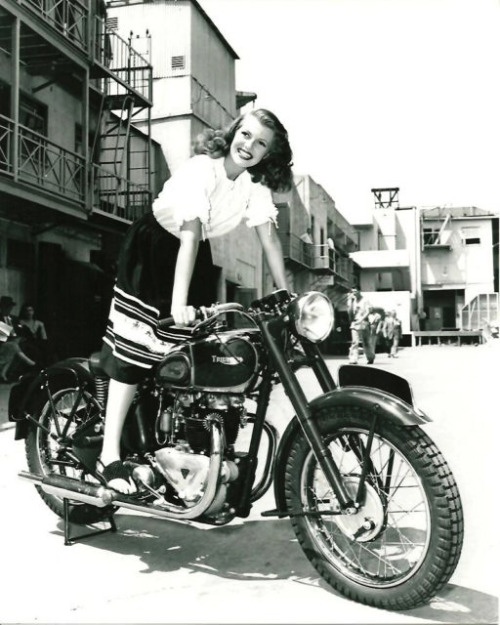
  Rita Hayworth, one of Hollywood's most glamorous leading ladies dies.


  One of Edward Turner's (Triumph Motors Managing Director of Engineering) favorite personal photo's was that of Rita Hayworth posing with him on the first post-war Thunderbird to be shipped to California on his first visit to Los Angeles in July of 1945.


  While a guest of W.E. Johnson Jr, the head of Triumph's American distributor Johnson Motors Inc., Mr. Johnson talked to "a guy he knew" at Columbia Pictures and arranged for Turner to take in the making of a Hollywood movie and afterwards is introduced to one of the movie's main attractions, Rita Hayworth.


  Edward Turner would return to Coventry toward the end of September, as in his words “All good things must come to an end.”  He expressed himself as thoroughly enjoying his visit, especially the hospitality of sunny California.  And meeting Rita Hayworth.


Monday, May 13, 2013

Today in motorcycle history, May 13, 1962


  The French motorcycle Grand Prix is held at Charade Circuit (also known as Circuit Louis Rosier and Circuit Clermont-Ferrand) in the Auvergne mountains in France near Clermont-Ferrand, which, by the way, just happens to be the home of Michelin.  Ooh, la-ti-da.

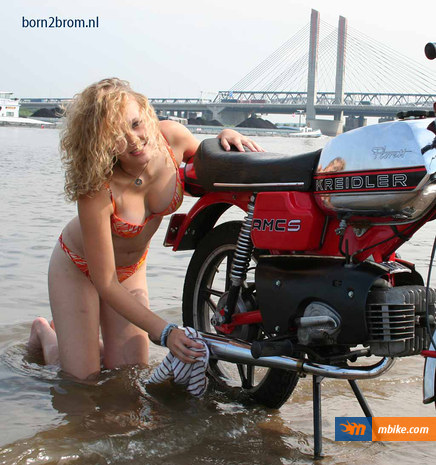
  Dutchman Jan Huberts wins the French Grand Prix 50cc Class aboard his Kreidler beating Japan's Kunimitsu Takahashi.


  Kreidler built small displacement motorcycles and mopeds, based in Kornwestheim, Germany.  The company was founded in 1903 as "Kreidlers Metall- und Drahtwerke" (Kreidlers metal and wire factory) by Anton Kreidler.  They didn't start producing motorcycles until 1951 and by 1959 one third of all German motorcycles were Kreidler!

  Eventually moving to racing Kreidler found great success with riders like Huberts, Jan de Vries, Henk van Kessel, Angel Nieto, Eugenio Lazzarini and Stefan Dorflinger claiming eight World Champion titles for the factory.

  But, alas, the company went out of business in 1982.  The rights to the trademark were sold to Rudolf Scheidt who had Italian manufacturer Garelli Motorcycles make mopeds under the Kreidler name until 1988.


Friday, May 10, 2013

Today in motorcycle history, May 10, 1957


  Bruce Lee Penhall is born in Balboa, California.  Soon teenage girls everywhere would be pasting his picture on their walls and inside their locker door.


  Bruce Penhall was well known for his role as Cadet/Officer/stud Bruce Nelson riding alongside his partner Ponch, a role immortalized by Eric Estrada, in the final season of the television series CHiPs.


  But, before he was Ponch's stable-mate he was a World Speedway Champion racer riding for the successful Cradley Heath Heathens speedway team in the United Kingdom from 1978-1982.

   The 1981 Speedway season proved to be Penhall's all conquering year.  Racing at the World Final at London's Wembley Stadium, 92,479 people witnessed Bruce Penhall come from behind to beat both former World Champion Ole Olsen of Denmark and later another Dane Tommy Knudsen on the finish line.  Also in 1981 Penhall partnered fellow American Bobby Schwartz to win the World Pairs Championship in Poland and alongside fellow World Finalist Erik Gundersen of Denmark led Cradley all the way to their first ever league title victory, topping the individual league averages on the way.  On top of a clean sweep of all the SWAPA personality awards was a special citation from US President Ronald Reagan.  *Seriously.  I couldn't make this shit up.


   He retired from speedway racing the night he won his second World Championship in 1982 in front of his home crowd at the Los Angeles Memorial Coliseum.  See * above. 


  Bruce was not only Bruce Nelson, but Bruce Christian in the 1989 film Savage Beach and five of the movie's sequels as Bruce, Bruce, Bruce, Bruce and Bruce.  Bruce then reprised his role as Officer Bruce in the 1998 television movie CHiPs '99.  There's a Monty Python sketch here somewhere.  


  In 1999, Penhall was inducted into the A.M.A. Motorcycle Hall of Fame.  


Thursday, May 9, 2013

Today in motorcycle history, May 9, 1956


  Supercross racing is born.


 I know, I know, Supercross is our "baby", it was born right here in the U.S. of A., oh, really...


 On May 9, 1956 in Prague, Czechoslovakia, 80,000 fans filled Strahov Stadium to watch the "Great Victory Day Race" (Great Victory Day marked the liberation of the Czechoslovakian Socialist Republic from Nazi Germany by the Soviet Union).

  Off-road motorcycling had already become a major sport in post-war Czechoslovakia, so there was plenty of interest in such an event, and plenty of talent to thrill the fans.  But there wasn't adequate public or personal transportation to take great throngs of people into the countryside, so the idea of staging a race for people to enjoy in comfort in the very center of Prague was only logical.  In addition to motocross in the infield, the fans were treated to speedway races around the perimeter oval.  The motocross course twisted over a half-mile circuit that included a steeple-chase type water crossing and seven or eight jumps (sound familiar?), which were created by piling dirt on wooden ramps.           


   But because of the political nature of the holiday, only Czechs and riders from neighboring Iron Curtain countries were allowed to participate, and only motorcycle brands from the region, (i.e. ESO, Jawa, CZ, MZ and Junak), were to be raced.

   Due to state-controlled communication on both sides of the Curtain, Western riders and motocross fans had little knowledge of or interest in the event.  However, Czechoslovakia was not the only nation of the Cold War era to come up with the idea of taking racing to the people.  British world champion Jeff Smith recalls participating at international meets held in soccer stadiums in Belgium at night under piss-poor lighting.


  16 years later, at Daytona International Speedway, the "first" Supercross race would be held.         


Wednesday, May 8, 2013

Today in motorcycle history, May 8, 1960

  Jock Weddell and his Norton
                                                         

  Victor Devine Motorcycles, Glasgow, Scotland, opens it's doors.


  Originally established as Weddell and Devine in Clydebank, Scotland,  in 1948.  "Jock" Weddell and Victor Devine both were well-known Norton and BSA racers.  As well as his TT successes Jock was one of the first British riders to compete on the European circuits.

 Unfortunately, circumstances led to their partnership being dissolved in the late 1950's.  Not to be deterred, Victor established the current shop on May 8, 1960 at the St Georges Cross end of Great Western Road.  Originally selling Iso Milano, Bianchi and Ducati but, by the mid sixties he was firmly established as Glasgow's premier Triumph dealer and by the end of the decade BSA and Norton.  With times-a-changin', 1970 saw Devine appointed as a Honda dealer.

  The shop moved from Great Western Road their current premises on Hydepark Street in the Spring of 2002.   Victor Devine Motorcycles is now considered one of the foremost Honda motorcycle dealerships in the United Kingdom.
  They have been putting Scotland on two-wheels for over 50 years now.  So, next time you're in Glasgow and are looking to buy a bike to check out Clydebank and the great distilleries of Scotland...oh, sorry...er..the great countryside of Scotland, their address is; 58-60 Hydepark St, Glasgow, Lanarkshire G3 8BW, United Kingdom.


  Remember kids, don't drink a lot of single-malt scotch and drive.