Wednesday, March 20, 2013
Today in motorcycle history, March 20, 1887
Orie Steele was the leading AMA Hillclimb Champion of the 1920s and early ‘30s, at a time when the sport was at its height of its popularity. Steele was a factory Indian rider for much of his career and was one of the best known riders of his era.
Steele followed up his 1922 national championship success with a national title in 1923 in the 37-inch class. In 1926, he swept all three national championship classes. He also won the Eastern National Hillclimb Championship in 1927.
Notable was the fact that Steele won all his national titles while he was in his 30s and 40s.
Tuesday, March 19, 2013
Today in motorcycle history, March 19, 1916
Pope Motorcycles introduces it's newest innovation, the cylindrical toolbox mounted on the rear fender.
Monday, March 18, 2013
Today in motorcycle history, March 18, 1961
A production Velocette Venom Clubman (single-cylinder, four-stroke, 499cc) sets the 24-hour endurance world record with an average speed of 100.05 mph.
It was the first motorcycle of any size to top 100 mph in the 24-hour endurance, and in 52 years and counting no other machine of the same capacity has been able to match or beat this record. The record attempt took place at the Montlhery Speed Bowl, a 2.7 km (1.67 mile) concrete track about 15 miles outside Paris that was well-known to riders as a track to have a very uneven surface and piss-poor lighting.
A team of six French riders were accompanied by motorcycle journalist Bruce Main Smith, who himself achieved the best lap time of 107 mph despite the track conditions. After securing the 12 hour record at more than 104 mph, the team then only stopped to change riders and refuel, and went on to set the 24 hour endurance record.
The publicity was huge for Velocette, as the success revived sales of the Venom which went on to become, alongside the Thruxton (worthy of a tale itself on another day), one of Velocette's best selling motorcycles.
However, the records were only set at the track not the cash register and in 1971 poor sales forced the company into voluntarily liquidation, with all the remaining stock and tools being sold off to pay creditors who had been lining up outside their door since the fall of 1969.
The Venom which set the 24 hour world record is now on display at the British National Motorcycle Museum. If for some reason you're going to be in the Birmingham area on holiday or for business the address is Coventry Rd, Bickenhill, Solihull, West Midlands B92 0EJ. The museum is open every day from 9:30am-5:30pm and in case you get lost or have a question the lads in the local can't answer just give 'em a call at 01675 443311.
Friday, March 15, 2013
Today in motorcycle history, March 15, 2002
Wednesday, March 13, 2013
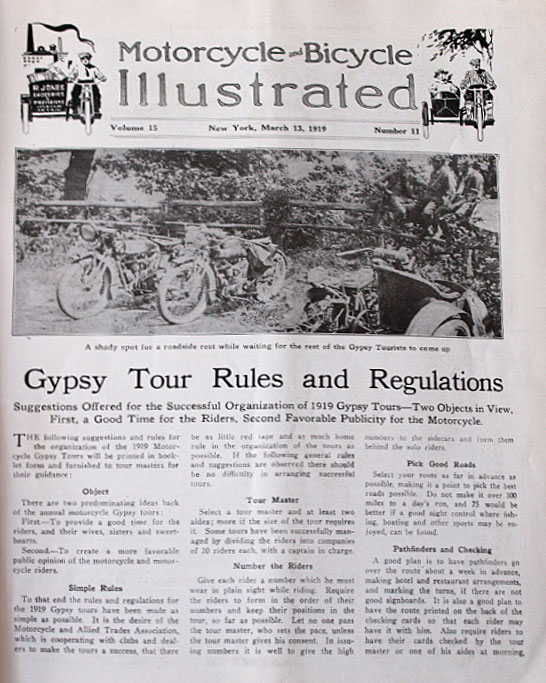
Today in motorcycle history, March 13, 1919


I came across this article from the March 13, 1919 issue of the"Motorcycle and Bicycle Illustrated"
magazine that detailed the objectives and rules for the Gypsy Tours for New York and New England. Being the kind sort I am I thought I'd share...
The objectives
were first, "to provide a good time for the riders, and theirs wives, sisters,
and sweet-hearts" (say what?); and second, "to create a more favorable public opinion of the
motorcycle and motorcycle riders."
These early Gypsy Tours were really, really organized, dare I say a precursor to the modern mc's, with a "Tour Master" and two aides
leading a large group of riders sectioned into "companies" of 10 riders and a
captain; and "pathfinders" scouting out and marking the route up ahead. The
riders wore visible numbers and were supposed to ride in numerical order, with
the sidecars taking up the rear of the company. The riders were also required to
carry documentation; these "checking cards" were reviewed each morning by the
"Tour Master" or his aides. This way there was no confusion over who's got the beer.
Tuesday, March 12, 2013
Today in motorcycle history, March 12, 1882
Erwin George "Cannon Ball" Baker, the man, the myth, the legend, is born in Dearborn County, Indiana.
A natural born entertainer, Erwin Baker began his career as a vaudeville performer, but turned to driving, riding and racing after winning a dirt-track motorcycle race in Crawfordsville, Indiana in 1904.
Baker's road to fame began with his record-setting point-to-point drives, in which he was paid to promote the products of various motorcycle and automobile manufacturers.
In 1908, with money from his promotional drives/rides, Baker bought imself an an Indian motorcycle and began entering, and winning, local races. He actually won the in first race ever held at the then newly built Indianapolis Motor Speedway in 1909.
Bored, Erwin felt he needed a road trip, so in January 1912 he bailed Indianapolis on a two-speed Indian and covered 14,000 miles in three months, traveling through Florida, down to Cuba and Jamaica, and then to Panama (and your buddy is still going on and on about his 507 mile trip). He then took a steamer up to San Diego where he based himself for a while and from there he competed in several endurance runs in both California and Arizona. It was during this time that Baker decided he would attempt to break the transcontinental record. After a record-setting transcontinental drive in 1914, he received his nickname "Cannon Ball" from a New York newspaper writer who compared him to the Cannonball train of the Illinois Central Railroad made famous by Casey Jones.
His best-remembered drive was in 1933. From New York City to Los Angeles in a Graham-Paige model 57 Blue Streak 8, setting a 53.5 hour record that stood for nearly 40 years. This drive inspired the later 'Cannonball Baker Sea-To-Shining-Sea Memorial Trophy Dash', better known as the "Cannonball Run", which itself inspired at least five movies and a really crappy television series.
The owner of many driving/riding records, his first was set in 1914, riding coast to coast on an Indian motorcycle in 11 days. Guaranteeing sponsor's "no record, no money".
When all was said and done, he made 143 cross-country motorcycle speed runs totaling about 550,000 miles.
Did you know, Erwin later became the first commissioner of NASCAR. Seriously. Look it up.
Nearly 40 years after he died (in 1960) Erwin Baker was inducted into the American Motorcycle Association Motorcycle Hall of Fame in 1998. That long? Really? You weren't sure if he qualified?
Subscribe to:
Posts (Atom)