
The New York Times reported that singer/songwriter Billy Joel was injured in a motorcycle accident on Long Island Thursday, and he is reported to be in ''quite good'' condition yesterday after major surgery at Columbia Presbyterian Medical Center in New York.
Dr. David L. Andrews, who performed surgery on Mr. Joel's right wrist and left thumb for two hours, said the singer should regain ''full activity in regard to his occupation'' in three to four months.
''He'll be fine,'' said Elizabeth Joel, the 32-year-old performer's wife. ''We're all highly relieved. He's in excellent spirits, he feels great, but his hands hurt.'' His hands will get well enough to divorce her and marry Christie Brinkley in 2 years time.
According to Sgt. Ted Avinila, of the Suffolk County police, Mr. Joel was riding his 1978 Harley Davidson through the intersection of New York Avenue and West Ninth Street in Huntington, L.I., at about 5:40 P.M. Thursday.
He said the bike struck a car driven by Cornelia Bynum of Huntington when she made a turn onto New York Avenue. The Pianoman was taken to a nearby hospital, then by helicopter to Presbyterian Hospital. He was said to be in a New York State of Mind.
As usual, the driver of the car was not hurt.


American International Pictures (AIP) releases the biker film "Hell's Belles". Directed by Maury Dexter and starring Jeremy Slate, Adam Roarke, Jocelyn Lane and Angelique Pettyjohn. Music by Les Baxter.
The most interesting part of this "biker" film are the characters involved in the making of. Shall we...
Maury Dexter had previously entertained worldwide audiences with The Day Mars Invaded Earth, Surf Party and The Mini-Skirt Mob.
Jeremy Slate (born Robert Perham) who's acting career included major roles in four "outlaw biker" films in the late 1960s: The Born Losers, The Miniskirt Mob, Hell's Belles, and Hell's Angels '69. As the leader of the Born Losers Motorcycle Club, Slate is a ruthless yet likable character who takes on Billy Jack. In Hell's Angels '69 (which he wrote the screen story) Slate played a man who uses the Hells Angels as unwitting dupes in a plan to rob a casino in Las Vegas; several real-life members of the Hell's Angels — including Angels president Ralph "Sonny" Barger, Terry the Tramp and Magoo — had significant speaking roles in the film. Slate broke his leg during filming and never rode a motorcycle again.
Adam Roarke (Richard Jordan Gerler) rode into the theatre's with roles in Hell's Angels On Wheels, The Savage Seven and Nam's Angels. Adam worked consistently in film and television, though mostly in small roles. His "breakout role" came in 1980 when he portrayed Raymond Bailey, a self-important leading man whose stunt double was played by Steve Railsback in The Stunt Man. Peter O'Toole befriended Roarke during filming, and the two became drinking buddies. Unfortunately, Roarke was unable to keep up with O’Toole, and was hospitalized with 'delirium tremens' before shooting was concluded. Word spread around Hollywood quickly, and Roarke had difficulty finding work as a result.
Jocelyn Lane was born Jocelyn Bolton in Vienna, Austria. At the age of 14, she moved to Britain where her older sister, Mara Lane, was a well-known British model in the 1950s. Jocelyn became a working model in the United Kingdom by the time she was 18, using the pseudonym Jackie Lane. She began appearing in several British films beginning in 1955 with the travelogue April in Portugal. Lane moved to Hollywood in 1964, she began to be credited with her full first name. Her resemblance to Brigitte Bardot worked to her advantage so much that she was featured in the September 1966 issue of Playboy magazine.
In 1965, she co-starred with Elvis in Tickle Me and later appeared in several roles in Hollywood films (such as the "biker chick" Cathy in Hell's Belles). She retired in 1971, having married Prince Alfonso of Hohenlohe-Langenburg in Marbella, Spain, in February 1971. In 1984, her marriage to Prince Alfonso ended in a divorce in which she received a million dollar settlement. She claimed that the sum was "not really fitting for a princess". You bet.
Angelique Pettyjohn. Oh, Angelique...born Dorothy Lee Perrins. During the 1970s, she worked as a burlesque star in Las Vegas. She was photographed by Robert Scott Hooper for the February 1979 Playboy pictorial "The Girls of Las Vegas". Angelique became quite popular at the Star Trek conventions and in 1979 Hooper photographed her in her "Shahna " costume from the episode "The Gamesters of Triskelion". They produced two posters, one in her complete costume and one nude without all the costume, that she sold at the conventions. During the early 1980s, she would make use of her buxom figure in such hardcore adult films as Titillation, Stalag 69, and Body Talk under the pseudonyms Angelique, Heaven St. John or Angel St. John. She later appeared in such cult classic features as The Lost Empire, Repo Man, Biohazard and Mike Jittlov's film The Wizard of Speed and Time.
Les Baxter. Many tales swirl about this man's musical history. Much too much to go into details here. Baxter worked for the film industry in the 1960s and 1970s. He worked on movie soundtracks for American International Pictures where he composed and conducted scores for Roger Corman's Edgar Allan Poe films and other horror stories and teenage musicals, including The Pit and the Pendulum, The Comedy of Terrors, Muscle Beach Party, The Dunwich Horror, and Frogs. Howard W. Koch recalled that Baxter composed, orchestrated and recorded the entire score of The Yellow Tomahawk in a total of three hours for $5,000.
Les Baxter has a motion picture star on the Hollywood Walk of Fame at 6314 Hollywood Blvd.
It seems to me that there should be a movie made based on the people that made this movie.


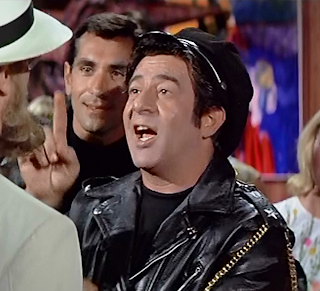

The scourge of beach blankets and volleyball nets, the bumbling, black-leather jacket-wearin' leader of one of Southern California's most infamous biker gangs (The Ratz and Mice) is born, Harvey Lembeck, aka Eric Von Zipper.
Appearing in six of the seven Beach movies (Muscle Beach Party being the one they were absent from) Eric Von Zipper and his gang of surfboard opponents did their best to ruin clubs, party's and romance of all those involved. Why, if it weren't for Professor Robert O. Sutwell and the Himalayan Suspension Technique they might have succeeded. The what?!
In the first Beach Party movie during an argument at Big
Daddys nightclub, the Professor is being threatened by Von Zipper so he quickly applies
his right index finger to a "key spot" on Zipper's left temple. This mysterious form of Far-Eastern self-defense -- which involves applying
pressure to some particular nerve in the victim -- results in putting them into
immediate state of temporary frozen unconsciousness. So, when Von Zipper is "frozen,"
it inevitably forces his gang to retreat, while carrying Lembeck off a member of the Ratz tells the crowd, "Eric Von Zipper will return."
Harvey Lembeck appeared on Broadway, the Silver Screen and television (Night Gallery, The Monkees and Man From U.N.C.L.E. to name a few) in a career that spanned over 30 years.
"Eric Von Zipper adores you. And when Eric Von Zipper adores somebody they stay adored."
EricEnequin (as a Rat named J.D. pompously pronounces "Eric
Von.Zipper will return.")


For the second time since a controversial American flag exhibit opened last month, protesters Saturday dismantled two of the displays showing American flags draped over a toilet and placed on the floor.
About 50 members of the “Vietnam Veterans Motorcycle Club” arrived on motorcycles, walked into the Phoenix Art Museum and removed the flags, said spokeswoman Amy Carr.
After removing the flags Saturday, the veterans carefully folded them, handed them to museum officials, then stood in line to write in a comment book placed in one of the displays. Before the flag was removed, visitors had to stand on the flag to write in the book.
“It’s insulting to the flag, insulting to America and insulting to us,” said John McFarland, a Vietnam veteran from Phoenix.
After an hour of what some might describe as heated debates with museum officials and other patrons, the protesters trickled out and the exhibits were reinstated.
Museum director Jim Ballinger defended the exhibit and said its controversial pieces will remain on display as scheduled,until June 16. "What this exhibit celebrates is freedom in America," he said. "We have a story to tell and we're not going to take away a crucial part of the story."
The always-entertaining House Speaker Newt Gingrich earlier this month jumped aboard the flag's bandwagon when he said he had declined an invitation to the exhibit, saying: “I don’t have to look at a U.S. flag in the toilet to know that it is wrong.”
Good 'ole Newt.


Dave Barr is born in Los Angeles, California, and left abandoned in the back seat of a car. After nine months in foster care, he was adopted by WWII Navy veteran Guy Barr and his wife, Lucille.
Dave Barr joined the US Marine Corps when he was 17 and served in Vietnam on a helicopter gunship. He earned 57 air medals, including a single-mission decoration for valor. After his discharge from the Marine Corp in 1972 he bought his first motorcycle, a ‘61 Harley-Davidson Panhead. He rode the Panhead coast-to-coast and then bought a new HD FX 1200cc shovelhead.
Still having the itch for something more, he served two years with the Israeli Parachute Regiment and one year in the Rhodesian Light Infantry. In 1981 while with the South African Defence Force riding in a military vehicle in southern Angola, his vehicle drove over an anti-tank mine and the resulting explosion cost him both of his legs, above the knee on the right and below the knee on the left. He spent nine months in a Pretoria military hospital, undergoing 20 operations, including four to remove his legs in stages, skin grafts, and agonizing physical therapy to learn to walk again. When he was released from the hospital, Barr volunteered to go back (?!) to the combat zone where he’d nearly been killed to finish his enlistment on prosthetic legs.
Barr mustered out in December 1982 and returned to his family home in West Covina, California. He took the Super Glide out of storage and refit it to accommodate his new life. He added an electric start and an overload spring to the brake pedal so he could ride with his artificial right foot resting on it. On his first ride, a casual thought occurred to him, and it put his life on a new course that would take him around the world and to some of its most extreme and challenging environments.
It was on the shovel that Barr would become the first double amputee to circumnavigate the globe. Seven years later he piloted the Super Glide out of Johannesburg, South Africa, on a 9,000-mile transcontinental ride to raise funds for the Leonard Cheshire Foundation, an international charity that assists disabled people. In September 1990, nine months after completing the African ride, Barr again left Johannesburg on the 18-year-old shovelhead, he turned north and kept going. Riding six of the world’s continents—he couldn’t find a way to get the bike to Antarctica—Barr logged 83,000 miles (including a 13,000 mile Atlantic to Pacific segment across Northern Europe and Siberia) through the world’s most dangerous and unforgiving regions during what turns out to be a 3½-year trip.
And then as a million others are whining about their sore knee, he decides, "fuck this", and sets a second world record for riding the so-called Southern Cross. In just 45 days during 1996, he completed the first motorcycle journey ever between the four extreme geographical corners of the Australian continent.
Dave Barr was inducted into the Motorcycle Hall of Fame in 2000 not only for his world record setting exploits, but also for the charity work he has done for the disabled along the way.

William Raymond Amm is killed during the 1955 Nations Grand Prix in Italy.
Originally from Salisbury in Southern Rhodesia, Ray Amm started grass-track racing near Salisbury when he was 17 years old after purchasing an 500cc AJS motorcycle. Being a novice to both motorcycles and racing, he finished last in his first race. So, blaming the bike, a we all do, the AJS was quickly replaced with a Triumph. Soon he found himself finishing in the middle of the pack, then fifth, fourth, third...
The purchase of a brand new Norton motorcycle allowed Amm to enter the prestigious 1949 Port Elizabeth 200 Motor-Cycle Race in South Africa and despite breaking the lap-record he finished in 17th place when the clutch started to slip. Refusing to call it quits he entered the 1950 Port Elizabeth 200. Ray finished in 1st place for the 500cc race and set a new lap record of 95.86 mph. Another win followed in the 500cc class for the 1951 Port Elizabeth 2000 Race despite suffering carburation problems. After these successes the Salisbury Motor-Cycle Club helped with his passage to compete in Europe.
Amm finally moved from the works Norton motorcycles to the factory MV Agusta racing team. His debut race for MV Agusta was to be the 1955 Easter Monday race meeting at the Autodromo Enzo e Dino Ferrari in Imola, Italy. Riding a 350cc four-cylinder MV Agusta in the Coppa d'Oro Shell Race, Amm lost control at the Rivazza Corner as he pursued Australian Ken Kavanagh and crashed in the slippery conditions.
William Raymond Amm died of his injuries on the way to hospital. He was 27.


"Little Honda" is recorded at the legendary Western Studios in Hollywood, California.
Written by Brian Wilson and Mike Love of the The Beach Boys and released on their 1964 album All Summer Long, and also featured on their EP, Four by The Beach Boys. It was covered by The Hondells, whose recording peaked at #9 on the U.S. pop singles chart, and later by Jan & Dean, Yo La Tengo, the Queers and the Demonics. The song pays tribute to the small Honda and its ease of operation, specifically the Honda Super Cub.
The Honda Super Cub, with it's four-stroke single-cylinder engine ranging in displacement from 49 to 109 cc has been in continuous manufacture since 1958. With production of the little bugger surpassing 60 million, the Super Cub is the most produced motor vehicle in history.
"Little Honda" peaked at #65 on the Billboard Hot 100 for the Beach Boys but became an international favorite, rising to #1 in Sweden and #8 in Norway in early 1965 and concurrently #44 in Germany.
In the US charts the Beach Boys' recording was particularly popular in Los Angeles, Washington DC and Minneapolis where it climbed to #2 in each city.
The Super Cub's 1960's US advertising campaign, "You meet the nicest people on a Honda", had a lasting impact on Honda's image and on American attitudes about motorcycling, and is considered a classic case study in marketing.
I remember that ad always made me want to puke.


