Monday, October 14, 2013
Friday, October 11, 2013
Today in motorcycle history, October 11, 1998
"In 1903, three Davidson brothers and their friend, Bill Harley, started a rumble heard 'round the world..."
Michael Sapherstein publishes his much-awaited analysis of Harley's attempt at registering a trademark on the sound of their V-Twin motor.
"If motorcyclists are a unique breed, Harley-Davidson motorcyclists must be considered a cult unto themselves. They have transformed the hobby of motorcycling into a lifestyle, replete with clubs, clothing, and a distinct "biker" culture.
The Harley-Davidson corporation's ability to evangelize the Harley lifestyle - as on the company's website - without alienating a customer-base which prides itself on being free-spirited and countercultural has been a testament to its marketing shrewdness. However, in a business expansion which probably irked the hardcore Harley faithful, the company now manufactures or licenses jewelry, watches, clothing, and a chain of "lifestyle" restaurants called the Harley-Davidson Café.
Harley-Davidson's most recent endeavor to secure trademark protection is not only its most unconventional, it is also arguably, the most unusual and provocative trademark application ever filed with the U.S. Patent and Trademark Office (PTO). On February 1, 1994, Harley filed a registration for a trademark, then already in use, with the following description: "THE MARK CONSISTS OF THE EXHAUST SOUND OF APPLICANT'S MOTORCYCLES, PRODUCED BY V-TWIN, COMMON CRANKPIN MOTORCYCLE ENGINES WHEN THE GOODS ARE IN USE." Put simply, Harley was attempting to trademark the sound of its motorcycles; which, of course, begs the question, can a manufacturer trademark the exhaust roar of its motor vehicle?..."
Fast forward to June 20, 2000......Harley-Davidson Inc. pulls the plug on its effort to obtain federal trademark protection for the syncopated "potato-potato-potato" (their words) chug of its idling V-twin motorcycle engine.
A Harley-Davidson spokesman said the company, which has been battling opposition to its trademark applications from other motorcycle makers for almost six years, "...is tired of tossing tens of thousands of dollars into a legal case with no end in sight."
Harley has long feared that the thump-thump-thump of its engine, a noise that can thrill or chill, depending on the listener's attitude toward bikes and bikers, would become the next 'nylon' - the early DuPont synthetic whose name wasn't protected and fast became a generic term.
But the bike maker was riding up a rocky road when it asked the government for a sound patent. According to an article published in the Los Angeles Times,"...as of 1998, only 23 of nearly 730,000 active trademarks had been issued to protect a noise, and most of those were for artificial arrangements, such as the roar of the MGM lion, NBC's three-note musical chime and the spoken "AT&T" superimposed over musical sounds."
The article goes on to say, "The maker of bikes, made notorious by outlaw motorcycle gangs in the 1950s and legitimized in the '90s by legions of lawyers, accountants and others who enjoy taking to the road on the throbbing cycles--said it is satisfied that its customers know well the look and sound of a Harley and will not be fooled by imitations."
"If our customers know the sound cannot be imitated, that's good enough for me and for Harley-Davidson," said Joanne Bischmann, vice president of marketing.
But yet, I wonder how many of these ladies and gentlemen on their Fat Boys, Wide Glides or Sportsters could tell the difference between the sound of some custom bike with an S&S motor or a Panzer or a Victory or a...
Wednesday, October 9, 2013
Today in motorcycle history, October 9, 1996
Two-Fat Ladies debuts on BBC2.
Clarissa Dickson-Wright and Jennifer Paterson, travel the United Kingdom, (except for one episode in Ireland and a Christmas special in Jamaica), on a Triumph Thunderbird motorcycle piloted by Paterson. The Triumph's registration is N88 TFL, the British bingo call for number 88 is "Two Fat Ladies-88", and had a Watsonian GP-700 "doublewide" (40"W) sidecar which was where Dickson-Wright sat and at times navigated. They traveled to various destinations, such as an army garrison or an all-girls school, an abbey or a seaside hotel, where they prepared large meals, often with unusual ingredients. Both of the ladies were very fond of strong flavors, often using anchovies, garlic and seasonings quite liberally. The recipes were all from an older time and tradition when rendered fat and drippings, raw eggs, and unpasteurized milk products were commonplace. Such as Clarissa's recipe for buttered Spatchcock (or Spattlecock) which has chickens covered with a thick layer of butter, bread and more butter on top of the bread! They emphasized the importance of using fresh ingredients of the very best quality, eschewing supermarkets for farms and roadside markets that they would seek out on their travels.
For you foodies reading this, the first episode takes them to The Shark's Fin Hotel in Mevagissey, Cornwall. They prepare crab, corn & coriander fritter, fish pie, scallops with leeks and gigot of monkfish romarin with anchovies.
Clarissa said that when they were told that their cookbook was a bestseller in Los Angeles, where the two thought that everyone seemed to live on lettuce and had a dollop of mayonnaise for treats, she said, "They must have been reading it for pornography."
******************************************Watsonian is the oldest (and arguably the best) sidecar manufacturer in the world.
T.F.Watson, a builder with a penchant for inventions, designed a folding sidecar to enable access through the side passages of terraced houses and in 1912 he established the Watsonian Folding Sidecar Co. at Balsall Heath in Birmingham, England. Since then the company has continued to produce great British sidecars, surviving two world wars, economic boom and bust and a major factory fire in 1930.
Tuesday, October 8, 2013
Today in motorcycle history, October 8, 1950

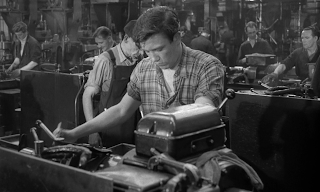
Gerald "Sussie" Cooper collides with Clive Bowen on a test run of the AJS 7R.
While riding side-by-side approaching a narrow bend in the road, a bird darted out hitting Sussie in the side of his helmet causing him to veer into Clive. Fortunately both riders would walk away relatively unharmed but, Cooper's frame, forks and front wheel were trashed. And, I'm afraid, so was his time as a test pilot, as he was terminated.
The AJS 7R, also known as the ‘Boy Racer’, was a 348cc racing bike designed by Phil Walker. The chain-driven overhead camshaft 7R had the history of the pre-war AJS ‘cammy’ singles behind it. Initially, the 7R was not as powerful as its competitors, only producing 32 bhp at 7500 rpm. The duplex frame and Teledraulic front forks remained relatively unchanged during production, while the engine had a number of changes. The included valve angle was progressively narrowed, and the crankshaft strengthened.
The next year Ike Hatch would develop a three valve head version of the 7R making a more powerful 36 bhp. The new design would become the 7R3, and was Ike's response to the Italian multi-cylinder bikes. In 1954 Jack Williams, the works team manager, developed the bike further, lowering the engine in the frame, and making some tuning changes that gave 40 bhp @ 7800 rpm. The changes resulted in AJS winning the first two rounds of the World Championship and took first at the Isle of Man TT.
Gerald Cooper, still living in Plumstead, London, retired as a machinist in 1992.
Monday, October 7, 2013
Today in motorcycle history, October 7, 2005
British Superbike racer John Reynolds crashes hard on the final practice round at Brands Hatch.
He would break four ribs on his right side, puncture his right lung and shatter his left collarbone. The accident also left him with what turns out to be career-ending injuries to his neck and back.
Reynolds said that he has practically no memory of his crash during that fateful Friday practice at Brands. "I don't remember much really. I came out of Druids, went down the hill and ran off the track. Simple as that."
Commenting from his hospital bed: "When I hit the barrier it was like a switch in my head flipped. Instantly I knew it was time to stop. I had received a warning with my broken leg earlier in the year (February, 2005). I see this as a final warning and I’ve made the decision to stop racing, more for my wife Shelley’s sanity and for the good of my family than for me."
The legend that is John Reynolds began in 1987 with a win on a vintage Velocette at Caldwells to winning the British Superbike Championship in 1992, 2001 and 2004 including a run of 11 consecutive podiums at the start of 2004.
Not bad for a lad from Kimberley, Nottinghamshire.
Friday, October 4, 2013
Today in motorcycle history, October 4, 1977
For the first time in 9 years Portlandian's feel the wind in their hair.
In 1967, to increase motorcycle helmet use, the federal government required the states to enact helmet use laws in order to qualify for certain federal safety programs and the above highway construction funds (no, really, your health and well-being are our top priority not the monies). The federal incentives or rather the threat of a reduction in construction funds worked! State after state fell to the federal “blackmail” threat. In Oregon the legislature first instated helmet use laws on January 1, 1968 where they remained in place until 1977.
As an aside, in Issue No. 3, October 1971, EASYRIDERS started a non-profit organization just for bikers. It was called NCCA (National Custom Cycle Association). One must keep in mind that back in 1971, no other motorcycle magazine except Roger Hull’s “Road Rider” was even giving an inch of space to anti-bike legislation. Editor Lou Kimzey saw fit to take on the extra burden of starting a motorcycle rights organization.
It wasn’t long until Kimzey changed NCCA to ABATE, A Brotherhood Against Totalitarian Enactments, the acronym fit at the time as unelected federal bureaucrats were in fact using coercion on state legislators to have specific laws enacted within the states.
In 1976, states successfully lobbied Congress to stop the Department of Transportation from assessing financial penalties on states without helmet laws and shortly thereafter began a pattern of repeal, reenactment, and amendment of motorcycle helmet laws. Specifically in Oregon, on October 4, 1977 the helmet law was repealed for age 18 and over.
Now don't throw your helmet away just yet, the helmet law has since been reinstated but, there is no helmet speaker law or handlebar height restriction. Bad-ass, super tall apes with Motorhead cranked up enough to make your ears bleed while blasting down Route 6 is A-OK.
Wednesday, October 2, 2013
Today in motorcycle history, October 2, 1936

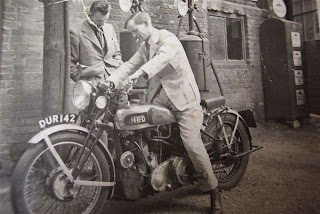
The Vincent HRD Series A Rapide is introduced.
The story is that supposedly Phil Irving accidentally put a side-view tracing of the Vincent 500 motor wrong way up on top of an equally sized drawing of the same view of the same motor, and saw, moving the tracing so the crankshafts and idler gears coincided, that the result looked like a possible design for a V-twin. This resulted in the 47.5 degree V-twin.
The new Vincent V-twin incorporated a number of new and innovative ideas, some of which were more successful than others.
The Series A Rapide's frame was of brazed lug construction, based on the Comet design but extended to accommodate the longer V twin engine. It continued the use of "cantilever" rear suspension, which was used on all Vincents produced from 1928 through 1955. Other improvements/innovations included a Burman 4-speed gearbox, 6.8:1 compression, 1.0625 inch Amal carb and a side stand.
Both Phil Vincent and Phil Irving refused to use pneumatic forks believing girders were superior at the time. The Series-A had external oil lines and a separate gearbox. The 998cc Series A Rapide Vincent cost $600, produced 45 hp, and was capable of 110 miles per hour.
The high power meant that the gearbox and clutch did not cope well and led to many a breakdown. Too many in fact, leading to the Series B Rapide's radical changes in 1946. (50 degree V-twin instead of 47.5, internal oil lines, unit construction, etc.)
An interesting Vincent fact for you; in 1948, Indian Motorcycles distributed Vincents in the States along with other British motorcycles including AJS, Royal Enfield, Matchless and Norton Motorcycle Company. That same year an Indian Chief was sent to Stevenage to be fitted with a Vincent Series B Rapide engine. Unfortunately, the resulting hybrid "Vindian" never went into production. Can you imagine it?! The mind runs wild.
Subscribe to:
Posts (Atom)