Tuesday, October 14, 2014

Today in motorcycle history, October 14, 1962


  One of the top privateer racers in the history of the Grand Prix circuit, Arthur Wheeler wins the 250cc class Argentine Grand Prix aboard his ever-trusty Moto Guzzi.


  Born in Epsom, Surrey, Arthur Wheeler left school at the age of fifteen to be an apprentice electrician and engineer. With his first paycheck he bought a set of leathers and an old black "pudding basin" helmet from his uncle, the Brooklands race veteran Frank Taylor.  He was initiated into Grass Track racing riding a Mark IV Velocette at pre-war venues all over the south-east of England. Then, in 1936, against his parents' strong opposition, he rode at Brooklands in a "Clubman's Day".  Although he finished third in two races, reaching speeds of 81.5 mph, his father forced him to sleep for three nights in the garden shed with his Triumph Tiger 100 as a "penance", intended to cure Arthur of his racing bug, it failed to work. 


  Arthur used his bike skills to open a small, one-man bike shop in 1937, using all the profits to enable his motorcycle racing career. With the outbreak of World War II, Wheeler's engineering skills led him to being chosen to work alongside the legendary scientist (and fellow bike nut) Sir Barnes Wallis in developing the "bouncing bomb".


  After the war, he travelled to the circuits around the British Isles and Europe the hard way, transporting himself and his bikes in a 1945 Morris van that had a top-speed of only 45 mph!


  Wheeler won the 1954 250cc class Nations Grand Prix at Monza after the dominant NSU factory racing team withdrew from the race.  He was a five-time winner of the North West 200 race in Northern Ireland and won the Leinster 200 at least twice and had a fourth place finish in the Isle of Man Lightweight TT.


  Only five months before his death at 84, Arthur Wheeler was racing Classic class motorcycles in Australia on his prized 250cc Moto Guzzi.


  Today in motorcycle history proudly supports the National Association for Bikers with a Disability (NABD).  www.nabd.org.uk

Monday, October 13, 2014

Today in motorcycle history, October 13, 1968


  On what turns out to be his last jump using a T120 Triumph Bonneville, Evel Kneivel crashes in Carson City, Nevada.


  Attempting to jump ten cars at Carson-Tahoe Speedway in Carson City, Nevada, Evel catches the roof of the last car causing him to crash on to the landing ramp. The "landing" breaks both his shoulder and his hip.  


  The Carson City jump will end his long relationship with the Bonneville.  He switches to a Laverda 750cc American Eagle in  April of 1969.  Evel Kneivel will leave the Laverda (in pieces) for a Harley-Davidson XR-750 in December, 1969. 


  It's the XR-750 that he becomes associated with on everything from lunchboxes, die-cast and plastic models, bed sheets, T-shirts, jackets, yo-yo's, dolls, pinball machines, posters, sunglasses, board games, etc.


 Viva Evel Knievel!


   Today in motorcycle history proudly supports the National Association for Bikers with a Disability (NABD). www.nabd.org.uk

Monday, October 6, 2014

Today in motorcycle history, October 7, 1906


  Alabama State Fairgrounds Raceway opens with a motorcycle duel in the dirt, Harley-Davidson vs Indian. 


  They came to the Five Points West neighborhood of Birmingham, Alabama to see the countries' leading professional racers compete on the one-mile dirt oval. The track featured a modern covered grandstand down the front stretch making Birmingham a popular spot with professional motorcycle racers from across the country. So popular that many would spend their winters there honing their racing skills.


  The original one-mile dirt oval was built as a horse track. On October 7, 1906 the track hosted its first motorcycle race, followed by an automobile race three days later. Motorcycle racing continued at the Fairgrounds until just after World War I, when the focus shifted to both motorcycle and automobile racing.  A 10,000 seat grandstand was built in 1925. The dirt track was shortened to a half-mile circuit in 1932 and t
he smaller configuration was used until July 4, 1942, when it closed for World War II. It was reopened on October 1, 1946, and began hosting weekly auto-racing events organized by promoter J. P. Rotton.


  A quarter-mile dirt oval was added in 1958 and was the first track to be paved and then it was renamed Birmingham International Raceway. After one season of racing on the quarter-mile track the present five-eighths-mile course was constructed with its first race held on June 28, 1962. With new lighting the Sunday afternoon races were moved to Friday nights. Sadly, motorcycle racing was discontinued.


  The site is now home to the Birmingham Crossplex, a natatorium and indoor track and field facility.


  Today in motorcycle history proudly supports the National Association for Bikers with a Disability (NABD). www.nabd.org.uk

Today in motorcycle history, October 6, 1934


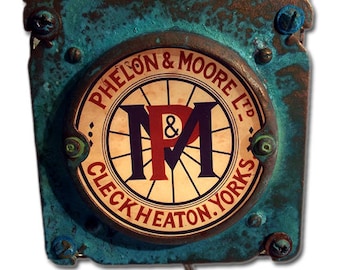
  A Phelon & Moore Red Panther 250cc single wins the coveted Maudes Trophy.  


  The Maudes Trophy is a motorcycle award established in 1923 by George Pettyt, owner of Maudes Motor Mart based in Great Portland Street, London who promoted an impartially-observed endurance test for motorcycles. A different system of tests are used each year.


  Phelon & Moore manufactured a range of lightweight motorcycles, most carrying the name Panther or Red Panther, using their own four-stroke single engines and Villiers two-strokes. Opting to use their own four-stroke for their 250cc Red Panther, figuring they had nothing to lose and everything to gain, they entered the Red Panther in the 1934 Maudes Trophy endurance/performance race.  They capture the Silver Trophy with the 250's performance in the Land's End Run: average speed greater than 35 mph, fuel efficiency of 96.3 mpg and it's "hands-off" stability at and over 50 mph.


  The Red Panther was famous for being the cheapest complete bike available in Britain in the 1930's, priced under 30 pounds.


  Today in motorcycle history proudly supports the National Association for Bikers with a Disability (NABD). www.nabd.org.uk

Thursday, October 2, 2014

Today in motorcycle history, October 2, 1977


  Armed with a Pops Yoshimura Kawasaki, Wes Cooley wins the final AMA Superbike Series race of the season at Riverside, California.


  Wester Steven Cooley was a young, balls-to-the-wall rider who helped bring Superbike racing into the modern era. Before Cooley, a lot of the riders in Superbike Series were older, more conservative stiffies who rode European twin-cylinder "cafe racers." Suddenly, was it no longer en vogue to ride with a smooth, European style. Cooley came in with four-cylinders flamin', rear tire smokin' and the front wheel in the air. He became the face of the new Superbike class.


   Bike-mad and with an understanding of how engines worked and what to do to improve them, Pops Yoshimura arrived in America in 1971 and five years later, in 1976, he put the "cat among the pigeons" in the newly formed AMA Production Superbike Series. 


   While Yoshimura could coerce obscene amounts of power out of an eight-valve, four-cylinder Kawasaki, the rest of the bike he wrapped around the massive power plant couldn’t handle it, it didn't help that the handling of the big KZs was already notoriously bad.

  "The tires back then?" said Wes Cooley with a laugh. ‘Ha, they were really different. Nothing like they’ve got now, that’s for sure. When I started riding the Kawasaki 900 it handled better with street tires than with slicks. It would hook up too good with the slicks, which would make the frame torque. I could get away with running plain old road Dunlops and make it slide better. With slicks it would just wobble all over the place."

  In the very first AMA Superbike Series race at Daytona International Speedway in March of 1976, Wes rode the Kawasaki to a fourth-place finish despite the machine's propensity for trying to shake him off his saddle at top speed around Daytona's high banks. A year later, Kawasaki returned with an improved bike, one with tires that handled marginally better and Cooley made it to the podium for the first time with a solid third-place finish.

  The final AMA Superbike race of the 1977 season was at Riverside, California. Wes Cooley rode the Pops Kawasaki to his first victory that day after a good battle with the Ducatis of Cook Neilson and Paul Ritter.


  Pops Yoshimura died in 1995, leaving a legacy as a master craftsman, tuner and fabricator and was one of the pioneering personalities of Superbike racing. In 2000, he was inducted into the AMA Motorcycle Hall of Fame, Wes Cooley would be inducted in 2004.


  Today in motorcycle history proudly supports the National Association for Bikers with a Disability (NABD). www.nabd.org.uk

Tuesday, September 30, 2014

Today in motorcycle history, October 1, 1999


  Seventeen year-old Toby Jorgensen dies from injuries he receives after crashing twenty days earlier during the 1999 AMA Grand Nationals in Dallas, Texas. 


  On September 11 Rookie Expert Toby Jorgensen, of Stockton, California, crashes through the inside turn two guard rail during the AMA Grand National Championship main event on the mile oval at Lone Star Park in Dallas, Texas. 


  The seventeen year-old had a distinguised amateur career with numerous victories at regional and national races dating back to 1989.  His professional debut was in the 1998 Hot Shoe Series, where he won the 600cc Pro Sport race at Spokane, Washington.  Jorgensen entered the Grand National Series in 1999 where he earned the respect and admiration of both fans and fellow riders, with a runner-up finish at the Peoria, Illinois, TT.


  Today in motorcycle history proudly supports the National Association for Bikers with a Disability (NABD). www.nabd.org.uk

Today in motorcycle history, September 30, 2014


  The new Ducati Scrambler will be presented today at Intermot, International Motorcycle, Scooter and E-Bike Fair, at Cologne, Germany.  


  The original Scrambler, for those unfamiliar, was a bare-bones, single-cylinder which Ducati made from 1962 until 1974, with engine sizes ranging from 125cc to 450cc, with the largest-capacity versions sold as the Jupiter. They were cheap, simple, easy to ride and nothing like the Ducatis we know and love today, which half explains the cult following they've picked up along the way. And it's that image which Ducati hopes to tap into with the new Scrambler.

  The production of the new Ducati Scrambler in 2015 is a salute to the American Berliner Motor Corporation.


  The 1962 Diana 250cc Mark 3 Super Sport had a top-seed of 104 mph.


  Today in motorcycle history proudly supports the National Association for Bikers with a Disability (NABD) www.nabd.org.uk