Monday, October 20, 2014

Today in motorcycle history, October 20, 1977


  On Thursday, October 20 at 6:42 pm, the Convair 240 carrying the band  Lynyrd Skynryrd crashes in Mississippi.


  Following another rollicking performance, this time at the Greenville Memorial Auditorium in Greenville, South Carolina, the band boarded a chartered Convair 240 to Baton Rouge, Louisiana where they were scheduled to appear at LSU on Friday night. 


  At 6:42 PM, the pilot of Lynyrd Skynyrd's chartered Convair 240 radioed that the craft was dangerously low on fuel. They were diverted to the McComb-Pike County Airport but, less than ten minutes later, after running out of fuel the plane crashed in a densely wooded thicket in the middle of a swamp five miles northeast of Gillsburg, Mississippi.  Ronnie Van Zant, Steve Gaines, Cassie Gaines, assistant road manager Dean Kilpatrick, pilot Walter McCreary and co-pilot William Gray were killed on impact; the other band members, Allen Collins, Gary Rossington, Leon Wilkeson, Billy Powell, Artimus Pyle, and Leslie Hawkins, tour manager Ron Eckerman, and members of their road crew suffered serious injuries.


  The often hard drinking, occasional brawling band were a favorite with biker crowds from Oakland, California to Nashua, New Hampshire, not to mention in their beloved Southland were they were everyman's brother. 
  

  Skynyrd's past and present members have owned motorcycles themselves such as Harley-Davidson's (ironhead Sportster, Shovelheads, Evo's), Honda's and a Kawasaki.

  There are two officially registered motorcycle clubs - Freebird MC and Freebyrd MC.


  I have been in bike-friendly bars in Rhode Island called "Gimme Three Steps" and another dubbed "The Breeze" whose sign has a Dave Man-esque biker on a knucklehead with the Skynyrd Confederate flag logo on the side of it's tank.  In 1992, I walked into a biker pub, "Barnstormers", in Dublin, Ireland at 3 o'clock in the afternoon on a Tuesday and "Gimme Back My Bullets" was cranking.  4,000 miles from Jacksonville.


  When was the last time you went to a swap meet or a bike show and didn't see a bike named "Free Bird" or hear a Skynyrd song?


   23 motorcycles in the US have license plates that read, "FREBRD".


   The new version (Johnny Van Zandt and Ricky Medlocke) played at Sturgis.  


   Today in motorcycle history proudly supports the National Association for Bikers with a Disability (NABD). www.nabd.org.uk

Friday, October 17, 2014

Today in motorcycle history, October 17, 1969


  Australian Champion and member of the Sheffield Tigers, Jim Airey graces the cover of "Speedway Star & News Magazine".


  Jim Airey would earn the nickname "King of the Royale" as he was near unbeatable on Sydney's 557 yard "Royale" Showground track.  At one point in his racing career Airey won an unimaginable 33 consecutive scratch races at the Showground.

  Jim would win the Australian Championship in 1968, '69 and '70, all held at the Sydney Showground. He would win a fourth title in 1972 at Rowley Park in Adelaide. 


  Airey rode quite successfully in Britain, riding for the Sunderland Saints for eight meetings in 1964 before moving to the Wolverhampton Wolves for the remainder of  '64 and then again '65.  After competing in Australia during the 1966 season, he returned to Wolves for '67 and '68.  He then signed with the Sheffield Tigers for 1969 and remained with the team until 1971 before retiring from the British Leagues and returning full-time to Australia.

  Jim Airey's greatest success came as a member of the Great Britain speedway team at Wrocław in Poland.  The British team featured he lone homeboy Ray Wilson,  Airey and New Zealand's Ivan Mauger, Barry Briggs and Ronnie Moore easily won the 1971 Speedway World Team Cup scoring 37 points to defeat the Soviet Union on 22 and host nation Poland who finished on 19 points.


  Oh yeah, the back cover of the magazine is a picture of the Belle Vue Colts, 1969  Division II Double Winners Squad/Team.


  Today in motorcycle history proudly supports the National Association for Bikers with a Disability (NABD).  www.nabd.org.uk


Wednesday, October 15, 2014

Today in motorcycle history, October 15, 1972


  The 1972 "6-Hour Production Motorcycle Race" promised to be the creme de la creme of them all due to all of the superbikes released in the previous 12 months; it turned it was, but not for that reason.


  Yamaha had released its super-trick TX750 and had signed a string of stars to ride the beast.  Kawasaki had upgraded the 500cc Mach Ill to 750cc and called it the Mach IV.  It was, hands down,   the fastest production bike ever released at that time. In fact for those not used to speed a diaper might have been a recommended option. Two brand new uber sexy Ducati 750's, an Interstate Norton with it's massive tank, a Triumph Trident and an MV Agusta 750 also lined up against the proven Honda 750's and 650cc Yamaha's.

  But the claimed winner came from the 500 class; Joe Eastmure on a Suzuki 315.

  Due to a lap-scoring error the circuit announcers and television commentators convinced themselves, the 12,000 spectators and one million TV viewers that Eastmure was on the same lap as Kawasaki Mach IV piloted by the team of Dave Burgess and Mike Steel.

  For the last half hour Eastmure and Steel fought out the lead and when Steel crashed with three minutes to go, Eastmure took the victory.  Half an hour later the lap sheets were checked and it was found that Steel had in fact won with 334 laps, Eastmure was third on 333 and the Ducati 750 team of Gates/Lawrence was second.

  When the post-race scrutinizing started, more interesting facts were discovered.  Eastmure’s barrels were non-standard and the horn was missing from his machine.  Much to Suzuki's chagrin, he was disqualified. The inspector's had an even greater shock when they lifted the head from the second-placed Ducati.  Larger pistons had been fitted with the capacity increased to a massive 890cc.  Arrivederci!

  Earlier in the race, the Yamaha TX75Os had made an embarrassing debut.  By twelve o’clock their three teams had all retired with mechanical woes. The TX never recovered from the publicity and faded from the showroom floor within 12 months.


  On a side note: The Kawasaki Mach IV's front disc brake decided to weld itself to the caliper costing it a certain high finish.  Before retiring it set a new lap record of 60.4 seconds.


  Today in motorcycle history proudly supports the National Association for Bikers with a Disability (NABD).  www.nabd.org.uk


Tuesday, October 14, 2014

Today in motorcycle history, October 14, 1962


  One of the top privateer racers in the history of the Grand Prix circuit, Arthur Wheeler wins the 250cc class Argentine Grand Prix aboard his ever-trusty Moto Guzzi.


  Born in Epsom, Surrey, Arthur Wheeler left school at the age of fifteen to be an apprentice electrician and engineer. With his first paycheck he bought a set of leathers and an old black "pudding basin" helmet from his uncle, the Brooklands race veteran Frank Taylor.  He was initiated into Grass Track racing riding a Mark IV Velocette at pre-war venues all over the south-east of England. Then, in 1936, against his parents' strong opposition, he rode at Brooklands in a "Clubman's Day".  Although he finished third in two races, reaching speeds of 81.5 mph, his father forced him to sleep for three nights in the garden shed with his Triumph Tiger 100 as a "penance", intended to cure Arthur of his racing bug, it failed to work. 


  Arthur used his bike skills to open a small, one-man bike shop in 1937, using all the profits to enable his motorcycle racing career. With the outbreak of World War II, Wheeler's engineering skills led him to being chosen to work alongside the legendary scientist (and fellow bike nut) Sir Barnes Wallis in developing the "bouncing bomb".


  After the war, he travelled to the circuits around the British Isles and Europe the hard way, transporting himself and his bikes in a 1945 Morris van that had a top-speed of only 45 mph!


  Wheeler won the 1954 250cc class Nations Grand Prix at Monza after the dominant NSU factory racing team withdrew from the race.  He was a five-time winner of the North West 200 race in Northern Ireland and won the Leinster 200 at least twice and had a fourth place finish in the Isle of Man Lightweight TT.


  Only five months before his death at 84, Arthur Wheeler was racing Classic class motorcycles in Australia on his prized 250cc Moto Guzzi.


  Today in motorcycle history proudly supports the National Association for Bikers with a Disability (NABD).  www.nabd.org.uk

Monday, October 13, 2014

Today in motorcycle history, October 13, 1968


  On what turns out to be his last jump using a T120 Triumph Bonneville, Evel Kneivel crashes in Carson City, Nevada.


  Attempting to jump ten cars at Carson-Tahoe Speedway in Carson City, Nevada, Evel catches the roof of the last car causing him to crash on to the landing ramp. The "landing" breaks both his shoulder and his hip.  


  The Carson City jump will end his long relationship with the Bonneville.  He switches to a Laverda 750cc American Eagle in  April of 1969.  Evel Kneivel will leave the Laverda (in pieces) for a Harley-Davidson XR-750 in December, 1969. 


  It's the XR-750 that he becomes associated with on everything from lunchboxes, die-cast and plastic models, bed sheets, T-shirts, jackets, yo-yo's, dolls, pinball machines, posters, sunglasses, board games, etc.


 Viva Evel Knievel!


   Today in motorcycle history proudly supports the National Association for Bikers with a Disability (NABD). www.nabd.org.uk

Monday, October 6, 2014

Today in motorcycle history, October 7, 1906


  Alabama State Fairgrounds Raceway opens with a motorcycle duel in the dirt, Harley-Davidson vs Indian. 


  They came to the Five Points West neighborhood of Birmingham, Alabama to see the countries' leading professional racers compete on the one-mile dirt oval. The track featured a modern covered grandstand down the front stretch making Birmingham a popular spot with professional motorcycle racers from across the country. So popular that many would spend their winters there honing their racing skills.


  The original one-mile dirt oval was built as a horse track. On October 7, 1906 the track hosted its first motorcycle race, followed by an automobile race three days later. Motorcycle racing continued at the Fairgrounds until just after World War I, when the focus shifted to both motorcycle and automobile racing.  A 10,000 seat grandstand was built in 1925. The dirt track was shortened to a half-mile circuit in 1932 and t
he smaller configuration was used until July 4, 1942, when it closed for World War II. It was reopened on October 1, 1946, and began hosting weekly auto-racing events organized by promoter J. P. Rotton.


  A quarter-mile dirt oval was added in 1958 and was the first track to be paved and then it was renamed Birmingham International Raceway. After one season of racing on the quarter-mile track the present five-eighths-mile course was constructed with its first race held on June 28, 1962. With new lighting the Sunday afternoon races were moved to Friday nights. Sadly, motorcycle racing was discontinued.


  The site is now home to the Birmingham Crossplex, a natatorium and indoor track and field facility.


  Today in motorcycle history proudly supports the National Association for Bikers with a Disability (NABD). www.nabd.org.uk

Today in motorcycle history, October 6, 1934


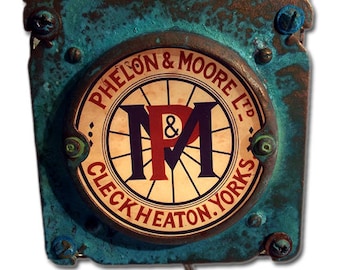
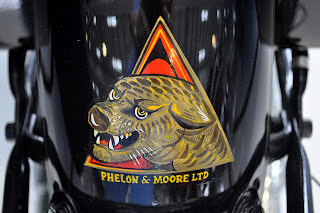
  A Phelon & Moore Red Panther 250cc single wins the coveted Maudes Trophy.  


  The Maudes Trophy is a motorcycle award established in 1923 by George Pettyt, owner of Maudes Motor Mart based in Great Portland Street, London who promoted an impartially-observed endurance test for motorcycles. A different system of tests are used each year.


  Phelon & Moore manufactured a range of lightweight motorcycles, most carrying the name Panther or Red Panther, using their own four-stroke single engines and Villiers two-strokes. Opting to use their own four-stroke for their 250cc Red Panther, figuring they had nothing to lose and everything to gain, they entered the Red Panther in the 1934 Maudes Trophy endurance/performance race.  They capture the Silver Trophy with the 250's performance in the Land's End Run: average speed greater than 35 mph, fuel efficiency of 96.3 mpg and it's "hands-off" stability at and over 50 mph.


  The Red Panther was famous for being the cheapest complete bike available in Britain in the 1930's, priced under 30 pounds.


  Today in motorcycle history proudly supports the National Association for Bikers with a Disability (NABD). www.nabd.org.uk