Monday, August 10, 2015

Today in motorcycle history, August 10, 2006


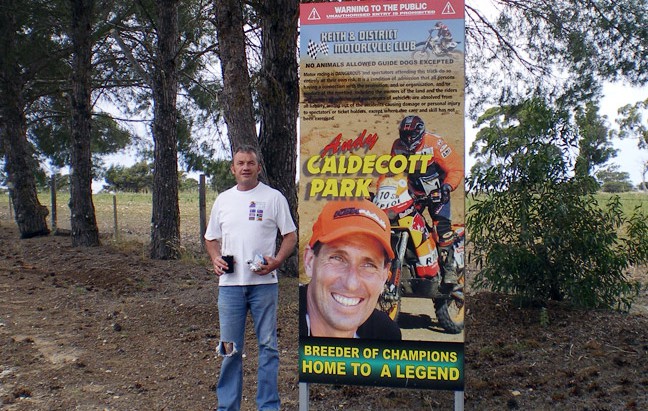
  Off-road motorcycle racer and Australian legend, Andy Caldecott is born in Keith, South Australia.


  Andy Caldecott won the Australian Safari Rally four times consecutively (2000–2003) and was a competitor in the Dakar Rally in 2004 (DNF), 2005 (6th), and 2006.


  Tragically, during the 2006 Dakar Rally Andy Caldecott died from a neck injury sustained in a crash during the ninth stage, 155 miles into the 372 mile special stage from Nouakchott to Kiffa. His death would be the 23rd in the 28 years of the rally.


   The local speedway track was renamed in his honor.


  Today in motorcycle history proudly supports the National Association for Bikers with a Disability (NABD). www.nabd.org.uk


Friday, August 7, 2015

Today in motorcycle history, August 7, 1972


  One of the great Grand Prix riders of the 1940's, Ulster's Artie Bell dies at 67.


  While riding his 1939 Norton, Artie Bell participated in several races in the immediate post-WWII period including the 1946 Cookstown 100 and winning both the 1947 500cc Ulster Grand Prix (where he set a new lap record of 94.79 mph) and the North West 200.

  Following his North West 200 performance Norton race manager Joe Craig signed him up for the 1947 works team. The 1947 Isle of Man was the perfect example of being thrown in the deep end. Other than a visit, along with his wife, to the Isle of Man in 1935 as a spectator he had absolutely zero experience there. Bell went to the Island two weeks before official practice began and spent the time doing intensive research and note taking, he applied himself to learning the most demanding circuit in the world.

  Regardless of his lack of experience, Bell led the 1947 Senior for three laps. When he pitted for fuel Craig ordered him to ease his pace. Artie obeyed his manager, allowing Harold Daniell to come through and win his second Senior. Bell’s second place and fastest lap in his very first Senior made the motorcycle world to take notice.

 The next season he claimed first in the Senior TT race and third in the Junior. In 1949 he placed third and fourth as well as winning the North West 200 again. When Norton introduced it's Featherbed frame in 1950 it would contribute to his winning the 1950 Junior TT and second place in the Senior. Artie Bell would win the North West 200 for a third time.

  Sadly, Bell's promising career came to an end following a crash at the 1950 Belgian Grand Prix. During the 500cc Class race at the extremely fast Spa-Francorchamps circuit, the leader Carlo Bandirola was being followed by Les Graham and Bell. When Bandirola braked early for La Source Hairpin, the AJS Porcupine ridden by Graham hit the rear wheel of Bandirola's bike. Graham was thrown clear and Bell hit both their bikes at high speed, slamming into a timing-post. Miraculously, Bell survived serious injury, but was unable to race again.


  In 1996 the Irish Post Office issued a set of postage stamps of notable Irish motorcyclists that included Artie Bell.


  Today in motorcycle history proudly supports the National Association for Bikers with a Disability (NABD). www.nabd.org.uk

Thursday, August 6, 2015

Today in motorcycle history, August 6, 1978


  Rick 'The Lumberjack' Burgett wins the 500cc Class Motocross at Pine Top Motorcycle Park in Escoheag, Rhode Island en route to laying claim to the 1978 AMA Motocross National Championship.


  Riding a 500cc two-stroke Yamaha, from July 2, 1978 at RedBud Track 'n Trail in Buchanan, Michigan to August 27, 1978 at Sunshine Park in St. Petersburg, Florida, a span of 7 AMA National races 'The Lumberjack' would win 6 and place third in the lone 500MX race he didn't win. 


  Straight out of the woods of Oregon, Rick Burgett was the first rider from the NW to taste the laurels of a National Championship. Admired and respected throughout the Motocross world, Burgett was inducted into the Washington State Motorcycle Hall of Fame in 2015.


  Today in motorcycle history proudly supports the National Association for Bikers with a Disability (NABD). www.nabd.org.uk


Wednesday, August 5, 2015

Today in motorcycle history, August 5, 1997


  "Dirt Track Lightning" Andy Tresser dies after crashing his bike during a race in Rapid City, South Dakota.


  During an AMA Grand National Championship race, Expert-ranked Andy Tresser of Redwood City, California, crashes in turn three on the half-mile oval at Black Hills Speedway.


   He would succumb to his injuries two days later at the local hospital. He was 32.


  Andy was rookie expert #10Y in 1990 and wore National #91 from 1991 until his death in 1997. He won one AMA Grand National and three AMA 600cc Nationals.


Today in motorcycle history proudly supports the National Association for Bikers with a Disability (NABD). www.nabd.org.uk

Tuesday, August 4, 2015

Today in motorcycle history, August 4, 2012


  One of those tales you hear in a bar and assume it's bullshit.  Well, it's not.  From The Spokesman-Review newspaper in Spokane, Washington...


  'Reclaiming an old hobby along with an old bike
Stolen motorcycle turns up 37 years later'

  by Meghann M. Cuniff  - The Spokesman-Review - August 4, 2012


  When Don Arndt’s motorcycle was stolen from the backyard of his old Spokane Valley home in 1975, he quickly lost hope of ever seeing it, but he never gave up his driver’s license endorsement to ride. He hasn’t been on a bike since, but he’d recently been thinking about buying a new one and rekindling an old hobby.

  Now an unexpected reunion has put Arndt in the driver’s seat sooner than expected. And it’s a familiar one.

   The 62-year-old Spokane resident picked up his 1972 Honda XL250 from the Washington State Patrol on Friday – nearly 37 years after it was stolen.

  “It’s unbelievable,” Arndt said.

  Someone who recently bought the bike took it to WSP seeking a title on Thursday. Inspector Donna LaMarca checked the motorbike’s vehicle identification number and realized it was possibly stolen. She viewed a Nov. 21, 1975, report from the Spokane County Sheriff’s Office, available only on microfiche, and left a message on Arndt’s answering machine.

  His wife sent him a text message that night as he worked the swing shift as an operator at the city of Spokane’s wastewater treatment plant.

  “It totally blew my mind,” Arndt said.

  Arndt said he found the motorcycle’s title about 10 years ago and threw it away. He said he concluded just a couple months after it was stolen that he’d never see the motorcycle again.

  “The police officer the day I filed the report just gave me no hope,” Arndt said. “That was the only contact I’d ever had with them.”

  He’d heard of many bikes being stolen at the time that were stripped and rebuilt. He figured his was one of them. He said he first expected to arrive at WSP’s headquarters and leave with a box of parts.
But the motorcycle, it turns out, is in great condition. It had apparently been in storage for about 15 years before someone purchased it recently and worked to make it road safe again.

  “Previous to that, the trail goes cold,” Arndt said.

  The person who brought the motorcycle in for inspection is not facing charges, said Trooper Troy Briggs, spokesman for WSP.

  “They bought it from somebody who gave them a bill of sale,” Briggs said. “The bill of sale said it had been in storage for 15 years and they didn’t have a title for it.”

  Arndt plans to restore the motorcycle and start riding it again. He owns property at Diamond Lake and hopes to take it out up there.

  “It’s just a matter of getting the bike all licensed and ready,” he said Friday. “I’ll probably ride it back and forth to work on nice days like these.”


  Today in motorcycle history proudly supports the National Association for Bikers with a Disability (NABD). www.nabd.org.uk

Monday, August 3, 2015

Today in motorcycle history, August 3, 1967


  "The Blue "un" merges with "The Green "un".


  'The Motor Cycle' was one of the first British magazines strictly about motorcycles. Launched by Iliffe and Sons Ltd in 1903, its blue cover led to it being called "The Blue 'un" to help distinguish it from its rival publication 'Motor Cycling', which, using a green cover, was known as "The Green 'un". Clever.


  Like everything else, the 1960's brought big changes; 'The' was dropped from the title, being then simply known as 'Motor Cycle', a readers' write-in 'Help Club', technical articles, tear-downs and repair how-to's, new model reviews, practical road riding, accessories, clubs and rally's.

  The biggest change came in 1967 with the merger of 'Motor Cycle' and 'Motor Cycling'. With the merger came the opportunity to change into newspaper format, 'Motor Cycling' had already changed to a broadsheet newspaper format five years earlier. Editor Harry Louis stated in the last magazine format dated August 3, 1967:

  "You'll get it a day earlier, on Wednesdays. The printing will be by the latest process, web-offset, which gives much brighter reproduction of pictures than has been possible in the past. With about twice as much space as in this issue, t
he new 'Motor Cycle' brings you all the features you expect plus much more extensive coverage of sport and news!"

  The two continued as one in the newspaper format, under the new name 'Motor Cycle Incorporating Motor Cycling'. They eventually realized how silly the name was and changed it to 'Motor Cycle Weekly'.


  'Motor Cycle Weekly' would remain in newspaper-format until 1983 when it reverted to magazine-format. After less than a year it folded.


  Today in motorcycle history proudly supports the National Association for Bikers with a Disability (NABD). www.nabd.org.uk

Friday, July 31, 2015

Today in motorcycle history, July 31, 1983


  Northern Ireland's Norman Brown and Switzerland's Peter Huber are both killed during the sixth lap of the 500cc Class British Grand Prix at Silverstone.


  As a light drizzle was falling, Norman Brown was seen coming down Hangar Straight with his left arm held straight up. He was riding slowly, about 40-50 mph, clearly experiencing mechanical problems and trying to get to the pits or waiting for a chance to get to the inside of the circuit. Norman took to the outside of the track going through the ever-fast Stowe Corner. Entering the corner he was in full view of riders coming down the straight at about twice his speed. A few riders safely overtook him before the corner, but as he exited Stowe, still holding the outside and waving his hand, he found himself on the racing line in a point where it was extremely difficult for the oncoming riders to see him.


  Three riders came out of Stowe and found Brown about 25 feet from the apex of the corner and 3 feet in from the edge of the track. All three managed to avoid him, two of them by passing on the outside on the small concrete overrun between the grass and the track. Brown continued on for another 100 feet or so when another group of riders approached Stowe. The last rider in the group was Peter Huber who had his view obscured by the bikes in front of him. As Huber exited the corner he turned his head back to check his position, as most riders do. In doing so he did not see the slow bike ahead of him and went full-speed into the back of Brown.


  Norman Brown was pronounced dead at the track. Peter Huber was airlifted by helicopter to the Radcliffe Hospital of Oxford, where he was pronounced dead on arrival. 


  Norman Brown was from Newry, County Down, North Ireland. Peter Huber was from St. Gallen, Switzerland.


  Today in motorcycle history proudly supports the National Association for Bikers with a Disability (NABD). www.nabd.org.uk