Thursday, September 10, 2015

Today in motorcycle history, September 10, 1959


  A rose by any other name...


  1959 was the last year that the TR6 did not carry a letter designation after it. Starting with model-year 1960, the TR6 model line would be offered in two variants, the TR6/A being the low-piped roadster version and the TR6/B the high-piped street scrambler. But for 1959, it was still known as the TR6 Trophy, alongside it's stablemate, the 500cc TR5 Trophy, essentially identical in every way but displacement, and now in its last season. 1959 Triumph TR6 engine numbers start with 020883 and end with 029688, and were built from November 8, 1958 to September 10, 1959.


  Today in motorcycle history proudly supports the National Association for Bikers with a Disability (NABD). www.nabd.org.uk

Wednesday, September 9, 2015

Today in motorcycle history, September 9, 1951


  Britain's Geoff Duke and his ever trusty Norton win the 1951 350cc Class Nations Grand Prix at the Autodromo Nazionale Monza circuit in Monza, Italy.


  Britain flexes it's Grand Prix muscle as riders Geoff Duke, Bill Doran and John Lockett finish the GP season one, two, three in the 350cc Class. Matter of fact, a Norton crossed the finish line four out of the first five (Bill Doran was on an AJS).


  Final 350cc Class Standings - Geoff Duke/Norton, Bill Doran/AJS, John Lockett/Norton, Ken Kavanaugh (Australia)/Norton and Jack Brett/Norton.


  Geoff Duke totally dominated the 350cc Class winning with 40 points (including 5 wins) to 19 points (1 win) by Bill Dolan.


  Among all the trophy's and accolades bestowed upon Geoff Duke the biggest was in 1953 when, in recognition of his services to motorcycling, he was awarded the Order of the British Empire.


  Today in motorcycle history proudly supports the National Association for Bikers with a Disability (NABD). www.nabd.org.uk

Tuesday, September 8, 2015

Today in motorcycle history, September 8, 1912


  At Valisburg Park in Newark, New Jersey, Motordrome racing has it's darkest day.


  The 8,000-seat Newark Motordrome opened on July 4, 1912 and regularly ran motorcycle races on Sunday afternoons. Racing fans from in and around Newark would pack the grandstands that ring the 60-degree, quarter-mile wooden "saucer" to see riders from around the country compete at speeds approaching 90 to 100 mph.


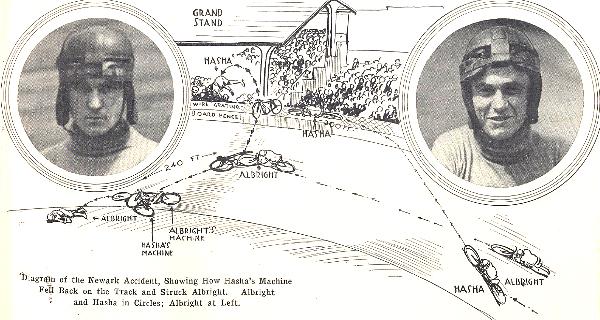
  On Sunday afternoon, September 8, Eddie "The Texas Cyclone" Hasha, John Albright, Arthur Chapple and Ray Seymore prepared to square off for a Five-Mile race (20 laps). On the third lap Eddie Hasha was leading fellow Indian rider Ray Seymore when Hasha's bike developed a hiccup, and Seymore took the lead. Eddie adjusted his carburetor, and then he re-entered the race at the top of the track. His bike suddenly took a sharp turn crossing the black warning line at the top of the racing surface. Travelling about a hundred feet along the three foot spectator railing at the top of the track, striking numerous spectators and then struck a large roof post and was hurled into the spectator seating area. Hasha's bike slid down the banking into the path of fellow rider John Albright, who was thrown from his bike.


  When the smoke finally cleared Eddie Hasha was dead of a broken neck, John Albright was seriously injured, and five spectators were either dead or dying. The crash, and resulting carnage, caused a stampede out of the grandstands, injuring numerous spectators. Albright died from his injuries later that day.

  The final death toll from the horrific crash was eight, which included Hasha, and Albright, along with six spectators. Three of the dead, were young boys twelve to fourteen years old.

  The Motordrome accident was the single worst in Newark motorcycle racing history. Newspapers across the country began tracking their local motordrome death tolls for the next year. Editorial writers and cartoons called for banning "Murderdromes" and motorcycle racing.


  Although the grand jury exonerated Motordrome management Oct. 26, 1912, its property was sold for $9,500 at a Nov. 24 sheriff's auction to satisfy a civil judgment. Inquests and litigation ended when a circuit court jury awarded $328 to four injured victims in a Jan. 15, 1914 judgment against EMRA.

  A Sept. 12, 1915 fire leveled the Motordrome. An Essex County Park Commission hired a demolition crew to clear the rest of the amusement center for Vailsburg Park in 1917.


  Today in motorcycle history proudly supports the National Association for Bikers with a Disability (NABD). www.nabd.org.uk


Friday, September 4, 2015

Today in motorcycle history, September 4, 1971


  Suzuki unleashes the GT750, a water-cooled three-cylinder two-stroke.


  The first Japanese bike with a liquid-cooled engine, the prototype was shown at the Tokyo Motor Show in October of 1970 and launched in Japan on September 4,1971. The GT500 was developed from their wildly successful T500 (Titan) with an extra cylinder and liquid cooling. Marketed as the GT Le Mans in the US and Canada, it was nicknamed the "Kettle" in Britain (for obvious reasons) and the "Damn Water Buffalo" (for obvious reasons) in the US. A heavy bike due it's Chevy-sized radiator it tipped the scales at 550 lbs. To give you an idea of how heavy that is, a 1972 Honda CB750 four cylinder weighs 518 lbs.


  Basic specs - 739cc, two-stroke water-cooled three-cylinder, 67 bhp @ 6500 rpm, 5-speed transmission, a top speed of 110 mph.


  The Automotive Engineers of Japan included the 1971 Suzuki GT750 as one of their 240 Landmarks of Japanese Automotive Technology. 

  
  240??!!


  Today in motorcycle history proudly supports the National Association for Bikers with a Disability (NABD). www.nabd.org.uk

Thursday, September 3, 2015

Today in motorcycle history, September 3, 2006


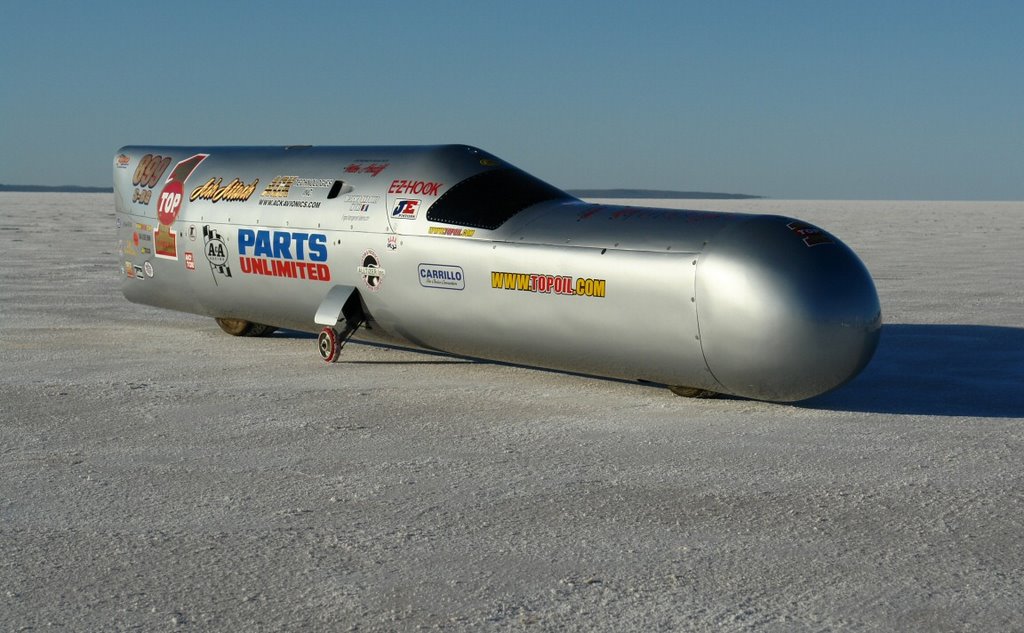
  Rocky Robinson, riding TOP 1 Ack Attack, breaks the FIM World Motorcycle Land-Speed Record at the Bonneville Salt Flats during the 2006 BUB motorcycle meet. 


  Rocky Robinson rides the 2,600cc, 1,000 hp, twin-engine Suzuki Top Oil-Ack Attack streamliner to a new World Land-Speed record. The motorcycle reached a speed of 342.797 mph, which was 20 mph faster than the previous record that had stood since 1991. 


  The owner of Ack Technologies, an avionics company, Mike Akatiff  was a motorcycle racer, machinist, mechanic, and parts builder. Akatiff first became interested in setting the motorcycle land-speed record in 2002. He dedicated a large portion of his company facility in Northern California to designing and constructing the Ack Attack, and then assembled a team of old friends help build the motorcycle.


  The Ack Attack crew - Ken Puccio, Crew Chief, spent numerous days and nights welding the chromoly steel frame and fabricating sheet metal. Master machinist Frank Milburn, had 50 years experience. Jim True was the first member of the team and an experienced land-speed racer, and Mike Akatiff's youngest son, Greg, handled all of the electronics, onboard video, cockpit recording, engine management system and was a heck of a beer run planner.


  Today in motorcycle history proudly supports the National Association for Bikers with a Disability (NABD). www.nabd.org.uk

Wednesday, September 2, 2015

Today in motorcycle history, September 2, 1979


  Riding a works Motobecane France's Guy Bertin wins the 1979 125cc Class French Grand Prix at Le Mans in Maine, France.


  Guy Bertin ends the 1979 Grand Prix season with back-to-back checkered flags.  Coming off his first-ever GP win at the Czechoslovakian Grand Prix he pilots his beloved Motobecane to victory in the race that meant the most, the French Grand Prix. A Frenchman winning a French race aboard a French motorcycle.


  Did you know that in 1936 Motobecane began production of a longitudinal shaft-drive inline-four in both 500cc and 750cc.  


  Today in motorcycle history proudly supports the National Association for Bikers with a Disability (NABD). www.nabd.org.uk

Tuesday, September 1, 2015

Today in motorcycle history, September 1, 1928


  Robert Pirsig, author of "Zen and the Art of Motorcycle Maintenance", is born in Minneapolis, Minnesota.


  "Zen and the Art of Motorcycle Maintenance" chronicles the 17-day motorcycle journey of the narrator, a former philosophy professor who underwent involuntary electric shock treatment for alleged insanity, across the country with his 11-year-old son. Along the way, the narrator ruminates on philosophical approaches to life, arguing that motorcycle maintenance is a metaphor for life. He demonstrates this by pointing out that maintenance may be dull and tedious drudgery or an enjoyable and pleasurable pastime; it all depends on attitude. Also along the way he succeeds in healing a deep emotional rift with his son.

  The book was rejected by 121 publishing houses before it was published by William Morrow and Company in 1974. Pirsig received only a $3,000 advance and was warned that the book would probably bomb. It became a cult classic, selling nearly 5 million copies to date. 


  Tragically, in 1979, Pirsig's son Chris, who figured prominently in the book, was stabbed to death during a mugging outside the San Francisco Zen Center.


  Today in motorcycle history proudly supports the National Association for Bikers with a Disability (NABD). www.nabd.org.uk