Thursday, November 5, 2015

Today in motorcycle history, November 5, 1954


  At the home of Chapin "Smitty" Smith, the Satyrs Motorcycle Club holds its first official club meeting. 


  The Satyrs Motorcycle Club is the oldest continuously operated gay motorcycle club in the United States, maybe in the World.

  According to their website, "The Satyrs MC helped spawn many motorcycle clubs across the nation in the early years. Many groups "borrowed and copied" the club's Bylaws in the early years as many clubs were unsure how to establish themselves after McCarthism of the 1950's."

  Sixty-plus years later the Satyrs Motorcycle Club continues to sponsor activities including the World-Famous 'Badger Flats Run'. More than just a run, it's billed as, '24-hour bar, food, camping and entertainment in the High Sierra's!' The club also does charity fundraising, has a longstanding history of community involvement and motorcycle relevant events.


  Websters describes a Satyr as "one of a class of lustful, drunken woodland gods. In Greek art they were represented as a man with a horse's ears and tail, but in Roman representations as a man with a goat's ears, tail, legs, and horns."


  Today in motorcycle history proudly supports the National Association for Bikers with a Disability (NABD). www.nabd.org.uk

Wednesday, November 4, 2015

Today in motorcycle history, November 4, 1905


  William Chadeayne rides into *Cheyenne, Wyoming, en route to San Francisco on his record-breaking transcontinental ride aboard his Thomas 'Auto-Bi'.


  William C. Chadeayne, Captain of the Buffalo Motorcycle Club, sets the record for the transcontinental crossing of the United States by a motor vehicle on a 1904 model 44 Thomas 'Auto-Bi', travelling from New York City to San Francisco via Chicago, Omaha, Cheyenne, Ogden (Utah) and Reno (Nevada). 3,800 hard-riding, ass-breaking miles on what now is known as I-80. The record time you ask, 44 days, 23 hours and 50 minutes. A cold beer never tasted so good.

   E.R. Thomas began manufacturing a tricycle powered by a De Dion-Bouton motor beginning on March 12, 1898. An early model of their 'Auto-Bi' (a motorized bicycle) was created in 1900, and public sales of the bike began in 1901. On September 17, 1901, a Thomas 'Auto-Bi' was mentioned in a Japanese newspaper article and went on sale eleven days later, advertised in the same newspaper.

   By 1903, the company was the largest manufacturer of single-cylinder, air-cooled engines.The 1904 'Auto-Bi' had a 2.5-hp, four-stroke 442cc, single-cylinder motor with a belt-driven transmission, capable of reaching speeds of 35 mph. The 'Auto-Bi' was later joined by the 'Auto-Tri', a three-wheeled motorcycle, and then they got fancy and offered the 'Auto-Two Tri', a motorcycle that could hold three riders.

   In 1905, E.R. Thomas motorcycle business was known as 'The Thomas Auto-Bi Company of Buffalo'. By 1912, the demand for Thomas' 'Auto-Bi' had dropped significantly, and the company discontinued all production of two-wheeled machines but continued building cars until 1919.


  A four-cylinder, 60 hp 1907 Thomas Model 35, known as the 'Thomas Flyer', won the 1908 New York to Paris Race, the first and only Around-the-World Automobile Race ever held. The race began in Times Square, New York, on February 12 and covered some 22,000 miles, finishing in Paris on July 30, 1908. Six teams started the race, one American, one Italian, one German, three French (De Dion-Bouton, Motobloc, and Sizaire-Naudin). Only three of the cars finished, the 'Thomas Flyer' which won, the German 'Protos', and the Italian 'Züst'. The original intent was to drive the full distance using the frozen Bering Strait to drive across the Pacific Ocean. In the course of the race, the Flyer was the first car to cross the United States taking 41 days 8 hours and 15 minutes, and in doing so, George Schuster became the first automobile driver to make the transcontinental crossing of the US in the winter. Schuster finished the Around-the-World Race in 169 days, an incredible feat considering the lack of roads and services in 1908.


  *According to 1900 census records, Cheyenne, Wyoming, had a population of 14,087, by 1910 the population had dropped 19.6% to 11,320 brave souls.


  Today in motorcycle history proudly supports the National Association for Bikers with a Disability (NABD). www.nabd.org.uk


Tuesday, November 3, 2015

Today in motorcycle history, November 3, 1926


  Known across California as "Mr. Vincent", the Vincent  riding, record-breaking, instructor and mechanic, Marty Dickerson is born in Inglewood, California.


  Marty Dickerson is best known for setting speed records on his own Vincent HRD Rapide during the 1950's. He set a Class 'C' record of 129 mph on the Bonneville Salt Flats in Utah in 1951. When the record was broken a year later, Marty came back with a 'new and improved' version of his Vincent in 1953 and turned in a run of 147 mph. That record held for 20 years.


  While hanging out at a local bike shop stories began circulating about a big British V-Twin that was the fastest thing on the road. Dickerson had a Triumph T100 that he had pushed to 94 mph and the thought of something faster piqued his interest, to say it lightly. He found out that the Vincent distributor and dealer for the bike was in nearby Burbank. One Saturday he rode his Triumph to Burbank to check out the vaunted machine. It was at Mickey Martin’s Burbank shop where he first laid his eyes upon a Vincent, and as odd as this may sound, it wasn’t love at first sight.

  "I thought the bike was ugly," Dickerson said, referring to the rough sand-cast engine cases. Still, he would go back to Martin’s shop almost every weekend, hoping to work out a trade for his Triumph. Martin eventually figured out a way to take the Triumph in on trade for a new Vincent. And in October of 1948, Dickerson finally had his rare and speedy British V-Twin.

  "It was a little scary to ride," he said of his first experience on the Vincent. "Starting the bike was a real chore and it took racer Tex Luse quite awhile to teach me the technique. On top of that, it had a light switch for a clutch – it was either on or off, real touchy. That was not a good thing to have with a bike that had so much power. I rode the bike home that day, and this was before all the interstates in L.A., so it was on city streets. By the time I made it home, I mastered how to start the thing and how to leave a stoplight without laying a black rubber patch all the way across the intersection."


  Marty Dickerson would take his Vincent to Bonneville in 1951 and set a Class 'C' record of 129 mph. His archrival at the time was Sam Parriott, who rode an Ariel Square Four. In 1952, Parriott and his Ariel broke Dickerson’s record on the Flats.

  Vincent founder, Philip Vincent heard of the Californian’s efforts and sent him some special cams and exhaust pipes from England. Marty studied the rulebook and found some loopholes that would allow him to do away with the standard seat and replace it with just a small pad low on the rear wheel well. He also turned his handlebars upside-down to give him a more streamlined riding position.

  Dickerson then went back to Bonneville in 1953 and shattered the Class 'C' record, turning in a two-way run that averaged 147 mph. During that run, he cracked the elusive 150 mph barrier in one direction. The 147 mph record held for a remarkable 20 years until a Yoshimura Kawasaki Z1 finally broke it in 1973, with a speed of 155 mph.


  Marty Dickerson was inducted into the AMA Hall of Fame in 2002.


  Today in motorcycle history proudly supports the National Association for Bikers with a Disability (NABD). www.nabd.org.uk

Sunday, November 1, 2015

Today in motorcycle history, November 1, 1956


Image result for elvis harley davidson model kh  Image result for elvis harley davidson model kh


  Elvis Presley buys a 1957 Harley-Davidson FLH. 


  While in downtown Memphis to insure his Lincoln Continental Mark II Elvis sees his friends at Memphis Harley-Davidson and buys a 1957 FLH. Later that day 19 year-old Natalie Wood climbs aboard and off they go for a 3-hour ride in the Memphis night accompanied by Elvis' pal, Nick 'Johnny Yuma' Adams riding  Elvis' 1956 KH Harley. And a Memphis motorcycle cop.


  I know, you're wondering what happened to the K Model? 


  When Elvis bought his FLH he then sold the KH to his riding buddy Fleming Horne, who eventually sold the bike—along with complete documentation including the bill of sale, registration paperwork and insurance documents, all signed by Presley—to Harley-Davidson in 1995. It has been the centerpiece of the Harley-Davidson Museum’s Pop Culture exhibit since the museum opened in 2008.


  Today in motorcycle history proudly supports the National Association for Bikers with a Disability (NABD). www.nabd.org.uk

Friday, October 30, 2015

Today in motorcycle history, October 30, 1917


  Robert M. "The Wheel Man" Keating sues the Harley-Davidson Motor Company for patent infringement.


  Robert M. Keating originally started the Keating Wheel Company in Westfield, Massachusetts on September 10,1890, needing more space the company relocated to Middletown, Connecticut on May 23,1896. They produced some of the lightest, strongest and fastest bicycles made in the United States, along with introducing the innovative and unique Keating curved center brace design, celebrated by the tag line, "See That Curve" on all its advertising.

  The Keating Wheel Company began manufacturing motor carriages, powered by electric batteries, for use as delivery vehicles in 1898. The following year the company changed its name to the Keating Wheel and Automobile Company and its first production model motorized delivery wagon was presented to the public on November 10, 1899. The giant Siegel-Cooper department store in New York City made the first purchase. Over the next several years some of the finest bicycles ever to be manufactured in the United States were rolled out of the factory's loading docks and shipped worldwide. By the turn of the century, the Middletown factory was also producing both electric and gasoline powered vehicles.

  In June and July of 1900, Keating filed a series of patents for a motorized bicycle and by November the first Keating motor-bicycle was tested on the company grounds using Keating's patented designs - patents that would become the industry standard for motorcycle production in America. In 1901, Oscar Hedstrom, under contract with the Hendee Manufacturing Company, leased space at the largely abandoned Worcester Bicycle Manufacturing Company, also in Middletown, to develop a motor-bicycle of his own. The Keating Wheel Company released their motor-bicycle onto the market in March of 1901. Hedstrom didn't complete his prototype, which would become the iconic Indian "Motocycle," until the end of May.

  Unfortunately, the Keating Wheel and Automobile Company ran into serious financial difficulties and went into receivership just as the Keating motor-bicycle was put on the market. On June 15, 1901, the Keating factory was sold to the Eisenhuth Horseless Vehicle Company. Over the next year they continued to build and sell the Keating motor-bicycle until it was abandoned to make way for production of the Eisenhuth automobile. Keating continued to develop engines for motorized bicycles and marine use in Middletown under the name Keating Motor Company until going into bankruptcy in August of 1906. The Eisenhuth Horseless Vehicle Company went belly-up five months later.


  On August 26, 1914, Keating sued the Hendee Manufacturing Company for patent infringement in their design of the Indian Motocycle, traditionally considered the first American motorcycle. On October 30, 1917, Keating sued the Harley-Davidson Motor Company for patent infringement. Keating won both suits. The Keating motor bicycle that was running around the Middletown factory in November of 1900 is the first original, commercially marketed motorcycle (that is, with the motor incorporated within the frame; not simply attached to) in the United States. 


  At the time of his death at 59, Keating held 49 patents--everything from bicycle and motorcycle designs to armchairs, swiveling bar/diner stools, modern flushing devices for toilets and the patent for the rubber home plate used in baseball (seriously, he invented it, before that it was wood or metal).


  Today in motorcycle history proudly supports the National Association for Bikers with a Disability (NABD). www.nabd.org.uk

Thursday, October 29, 2015

Today in motorcycle history, October 29, 1929


   'Black Tuesday', the Stock Market crashes. The employees of Excelsior-Henderson motorcycles are told, "Go home and tell your families that your jobs are safe."


  Partly due to financial reasons and shortages in raw materials because of the war, the Henderson Company offered to sell out to Excelsior in 1917. Ignaz Schwinn eventually accepted the offer and transferred production of Henderson from Detroit to the Excelsior factory in Chicago.


  Six months before the Stock Market crashed Excelsior-Henderson introduced the Streamline Henderson KJ. 


  Arthur “Connie” Constantine was one of the most preeminent motorcycle engineers of the 1920's, but his best work would result in one of the finest four-cylinder motorcycles ever to grace the roads. Constantine studied the already successful Henderson model, the 'DeLuxe' and came to the conclusion that a radical redesign was the only course of action that would improve the machine. His masterpiece was unveiled in March of 1929, the Streamline Henderson KJ. The advertisements boasted that the KJ had "57 New Features". The motor design reverted back to the IOE (inlet over exhaust) valve arrangement, but incorporated a five main bearing crankshaft, improved pressurized oiling and a down-draft intake manifold. It now put out 40hp up from 35hp the DeLuxe generated. Other jaw-dropping features were a redesigned frame that positioned the seat lower, new leading-link forks and an illuminated speedometer built into the gas tank. The motorcycle was capable hitting a genuine 100 mph.


  Henderson would continue to be a favorite with Police forces in the U.S. with more than 600 different forces choosing the brand over Harley-Davidson and Indian.

  On Tuesday, March 31, 1931, the company abruptly closed. Although the company had many orders from Police forces and dealers alike, Ignaz Schwinn decided that The Depression was going to get worse and so he decided to quit while ahead.


  At the height of The Depression unemployment in America reached 30 million. 


  Today in motorcycle history proudly supports the National Association for Bikers with a Disability (NABD). www.nabd.org.uk

Wednesday, October 28, 2015

Today in motorcycle history, October 28, 1964


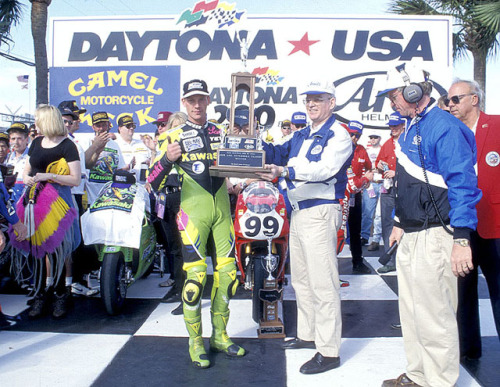
  Raymond Scott Russell, aka Mr. Daytona, is born in East Point, Georgia.


   Scott Russell's race history reads, World Superbike Champion, AMA Superbike Champion, three-time AMA Supersport Champion, won the Daytona 200 a record five times, and won the Suzuka 8-Hour in 1993. Oh yeah, did I mention that Russell is the all-time leader in 750cc AMA Supersport wins. Not bad for a guy who quit school to follow his dream, finding inspiration in Freddie Spencer's 1985 Daytona victory. Russell went from a job in a garbage bag factory to the podiums at racetracks all over the world.

   After racing motocross as a kid, Russell raced in WERA events before reaching AMA in 1987. In 1988 he was runner-up in the 750cc Supersport Class. He was Superbike runner-up in 1989, before winning the 750cc Supersport title three years in a row from 1990 to 1992 (winning every race in 1991). In 1992, Russell claimed the AMA Superbike Championship. His favorite race was the 1995 Daytona 200 where he crashed on the first lap, got back on the bike and won, finishing ahead of Britain's man of legend, *Carl Fogarty.


   Scott Russell was inducted into the AMA Motorcycle Hall of Fame in 2005.


   *Carl 'Foggy' Fogarty (MBE) is a four-time World Superbike Champion having been crowned in 1994, 1995, 1998 and 1999.


   Today in motorcycle history proudly supports the National Association for Bikers with a Disability (NABD). www.nabd.org.uk