Wednesday, January 13, 2016

Today in motorcycle history, January 13, 2015


  The much anticipated Indian Motorcycle Exhibit inside the Museum of Springfield History in Springfield, Massachusetts, opens.


  Some of the Indians in the exhibit I thought you might enjoy:


  A 1917 Model O Light Twin, which featured Indian’s horizontally opposed motor running front to back, NOT side to side.

  The 1925 single-cylinder Prince. Weighing in at 265 lbs and costing $185, it was aimed squarely at the entry-level rider. The marketing campaign included the slogan, “You can learn to ride it in five minutes!” That's about all the time you had, by 1929 production ceased.


  1926 Indian Scout was a nasty Hill Climb machine built for Bob Armstrong, a local hero in the 1920's. Armstrong's bike had a custom rear end, a more aggressive gear ratio and it ran on wood alcohol for fuel.


  And a 1937 Indian delivery van/motorcycle, or 'Traffic Car' as they were known. Built at the Indian Motorcycle factory it started life as an Indian Chief, powered by the same 42-degree, 74-cubic-inch V-twin as the two-wheeled model. But then, workers bolted a massive steel subframe to the rear of the bike and installed a jackshaft where the rear wheel should go. Sprockets on each side of the jackshaft turned drive chains to each rear axle, offering two-wheel drive. They were used to deliver everything from auto parts to ice cream.


  Today in motorcycle history proudly supports the National Association for Bikers with a Disability (NABD). www.nabd.org.uk

Today in motorcycle history, January 12, 2012


  At the 2012 Las Vegas Premier Motorcycle Auction a rarely seen Indian Scout "Junior" sells for $11,424.


  Unusual and rare compared to its big brother the more plentiful 45' Scout. This 1940 500cc "Junior" Scout was a good example of the smaller model. The bike was auctioned as 'complete and running'. This sweet bar-hopper is a definite head turner. 

  The 30.50' motor can cruise at 45mph but it has never been known to see the brighter side of 55mph. As one Indian aficionado was quoted as saying, "It'a great little bike but it can't pull the skin off a grape."


  Today in motorcycle history proudly supports the National Association for Bikers with a Disability (NABD). www.nabd.org.uk

Monday, January 11, 2016

Today in motorcycle history, January 11, 2008


  MotoUSA.com reruns a piece by it's contributing editor, Frank Melling, entitled "Memorable Motorcycles - Ducati Silverstone Super". 


  Forget being a cowboy out on the range, or a Spitfire pilot battling the Nazi hoards over the English Channel. I went to bed every night dreaming of riding a Ducati in the TT and receiving a kiss in the winner’s circle. I was a very confused nine-year-old.

  The reason was simple: Pre-Japanese, lightweight motorcycles were dull, dull, dull. Little bikes were for beginning riders, or the poor, or stupid, or those with no taste. Real men rode BSA Gold Stars and Velocette Venoms and Triumph T110's. Bikes which went grrrr and bared their teeth if you looked at them the wrong way or knocked their oil cans over at the bar.

  But as always, history is not straightforward. In Italy, lightweights were anything but boring or mundane – purely and simply because of the Italians’ love of racing.


  Fabio Taglioni designed a bevel drive, SOHC engine which appeared simultaneously in 100cc and 125cc forms to give Ducati two chances in the multi-class Moto Giro. The bike bore many of Taglioni’s trademark design traits. In reality, it was a very conservative concept that broke no new ground.

  Norton in particular had been racing bevel drive engines since the 1920's with incredible success. Unit construction engines, where the engine and gearbox are one item, had also been in production since before the First World War. What Taglioni did was to put all the best of known engineering practice into one, unified, package. The result was a neat, reliable and very beautiful, motorcycle.

  The engine was a typical Taglioni design. The heart of the Sport was an oversquare (62 x 57.8mm) high-revving, SOHC motor. As with all Taglioni’s motors, the cam was driven by a shaft and the wet sump kept the oil low in the chassis and the engine simple. In standard trim, power was a class-leading 14 hp at an astonishing 8,000 rpm. This gave an 85mph-plus performance – comparable with many 500's of its day.

  The race bike carried the exotic name “Silverstone Super”. Ducati provided a hotter cam, bigger carburetor, race exhaust and rev counter. A small pilot, glued to the fuel tank and with his knees tucked in, could expect to see a genuine 95mph, which was Grand Prix performance.

  Then there was the detailing. The razor thin saddle was designed for the rider to stretch right back, tucked into a racing crouch on the track – and looking cool on the road. The gas tank came complete with clips ready for a chin pad.

  So, clearly, the Sport is a bike every enthusiast would want to ride every day? Well, no. The rock hard suspension, narrow seat and low bars make for a very committed riding experience. The motor vibrates and the left-hand side kick start, mounted high on the engine case, is very much an acquired taste. In short, this is not a bike for the long relaxing mountain ride.

  But, man, it would look good in my garage.


  Today in motorcycle history proudly supports the National Association for Bikers with a Disability (NABD). www.nabd.org.uk

Friday, January 8, 2016

Today in motorcycle history, January 8, 2015


  At Bonhams Las Vegas Motorcycle Auction, held at the world famous Bally's Hotel & Casino, a 1990 Honda "RC30", frame no. JH2RC3000LM200204, sells for $52,900.


  One of the modern era's few immediately collectible classics, the Honda VFR750R - better known as the "RC30" - was created for just one reason: to win the World Superbike Championship, a feat it achieved in the budding series' first two seasons of 1988 and '89. And while American Fred Merkel was bringing Honda its first two WSB crowns, Britain's Carl Fogarty used an RC30 to win the TT F1 World Championship in 1988 and '89, and the equivalent FIM Cup in 1990. 

  Not just built for short circuits, the RC30 proved durable enough to win it's share of Endurance Classics, too. Part of the design had Endurance in mind with it's quick-release front fork and single-sided swingarm - essential for quick wheel changes. Those were only a taste of unrivalled specs that included a twin-spar alloy beam frame, 16-valve V4 engine with gear-driven cams, close-ratio 6-speed transmission and four-pot front brake calipers. All of which did not come cheap: at the time of its launch in 1988 an RC30 cost near double that of other Super Sport 750's. Despite the passage of time and progress of motorcycle technology, the RC30 remains a match for the latest generation of sports bikes but possesses an exclusivity that none of them can approach. According to 'Bike', "No other bike from the late-Eighties is lusted after like the RC30," and few would disagree.


  This RC30 was a beautiful street example, reported to be in stunning "as new" un-raced condition, showing a mere 754 miles on the odometer. The bike was meticulously stored and maintained from new.


  Today in motorcycle history proudly supports the National Association for Bikers with a Disability (NABD). www.nabd.org.uk

Thursday, December 31, 2015

Today in motorcycle history, December 31, 2007 & 2008


  I thought I'd share three New Year's Eve leaps from fabulous, Las Vegas, Nevada. 


  December 31, 2007 at the Rio Hotel - 
Australian daredevil/stunt rider Robbie Maddison, jumps more than the distance of an American football field, setting a World Record with a mind-boggling 322 feet 7 inches obliterating the previous Guinness World Record of 277 feet by Trigger Gumm.


  December 31, 2008 at the Mirage Hotel and Casino - Robbie Knievel was scheduled to jump the volcano at the Mirage Hotel. At the actual 200-foot jump, lame-ass Knievel gave the appearance of jumping the volcano, but limited the stunt to a ramp-to-ramp jump in front of the volcano with fireworks behind him. Lame.


  On the same evening only a cab ride away at Paris Las Vegas - Robbie Maddison, live on ESPN in front of a World-Wide audience, successfully jumped 96 feet up onto the Arc de Triomphe in front of Paris Las Vegas. Maddison caught his breath, took a lap or two around the roof, checked out the view and then descended an 80-foot drop off the monument to return safely to ground level. 


  Plans for your New Year's Eve? Try to not get arrested like last year, will ya?


  Today in motorcycle history proudly supports the National Association for Bikers with a Disability (NABD). www.nabd.org.uk

Wednesday, December 30, 2015

Today in motorcycle history, December 30, 1934


  Former multiple World Champion Speedway rider, Barry Briggs, is born in Christchurch, New Zealand.


  'Former multiple World Champion' barely seems to scratch the surface. Barry Briggs won four World Individual Championship titles – in 1957, 1958, 1964 and 1966. From 1954 to 1970 Briggs appeared in a record 17 consecutive World Individual finals, during which he scored a record 201 points.

 
  He was a six-time winner of the British Championship. He won his first in 1961 and then dominated the sixties winning in 1964, 1965, 1966, 1967, and 1969. Briggs also won his home title, the New Zealand Championship, twice winning in 1959 and again in 1963.


  He was crowned the London Riders' Champion in 1955, a three-time Midland Riders' Champion in 1966, 1967 and 1970 and was the Scottish Open Champion for 1967.


 Upon Briggs retirement from the sport he became a respected Speedway commentator in England and Europe, as well as the USA.


  In 1973 Barry Briggs was awarded an MBE for his services to sport and in 1990 he was inducted into the New Zealand Sports Hall of Fame.


  Today in motorcycle history proudly supports the National Association for Bikers with a Disability (NABD). www.nabd.org.uk

Tuesday, December 29, 2015

Today in motorcycle history, December 29, 1951


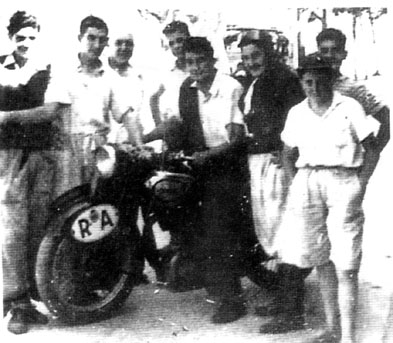
  Alberto Granado and Che Guevara begin their seven-months long road trip aboard Granado's Norton. A trip that will eventually change the lives of many. 


  On the morning of December 29, 1951, Alberto Granado packed his saddlebags, topped off the tank of his beloved 1939 500cc Norton (nicknamed Ponderosa II) and began what turns out to be a life-changing tour of South America with his friend Che Guevara. Throughout their continental excursion they both kept detailed journals as they witnessed first hand the poverty of disenfranchised native peoples and their frequent lack of access to otherwise cheap and basic medical care. The two men were especially deeply affected in Chile when they visited the American-owned Anaconda Copper's Chuquicamata copper mine and met men working their asses off for nothing more than pennies and suffering from silicosis (a form of lung disease caused by inhaling silica dust).  Granado later lamented that although he and Guevara were impressed by the mine's high-tech machinery, "this was eclipsed by the indignation aroused when you think that all this wealth only goes to swell the coffers of Yankee capitalism."


  The two friends encounters with South America's "downtrodden and exploited" such as the copper miners, migrant sheep shearers, and Indian peasantry were a major influence on both their lives. For Alberto Granado, it confirmed that there was a wider world to see and help than the middle classes of his hometown, while in Che Guevara it ignited a burning desire to tackle the cause of such misery, which he came to see as capitalism. These experiences also galvanized both men in realizing their future vocations — Guevara towards Marxist revolutionary politics and Granado to the pursuit of practical science.


  Today in motorcycle history proudly supports the National Association for Bikers with a Disability (NABD). www.nabd.org.uk