Thursday, April 17, 2014

Today in motorcycle history, April 17, 1958


  One of the greatest motorcycle riders of his time, if not all-time, Paul "Dare Devil" Derkum dies at 78.


  Born on July 2, 1881, he had the need for speed even as a youngster. By the time he reached his teens, he had already been racing bicycles nationally for two years.  Motorcycles were just a natural progression.

  Indian was the bike of choice for many of the early racers, but Paul J.C. Derkum literally made his name on a 1908 Indian twin.  On February 22, 1908, Derkum broke ten speed records at a one-mile dirt track in Los Angeles—clicking off the fastest time ever for a flying mile, two miles, three miles and so on up to ten miles!


  His achievements were chronicled in the California newspapers, with one Los Angeles reporter dubbing him “Dare Devil Derkum,” a name that stuck throughout his racing career.


  The following excerpt is from the Los Angeles Herald, July 27, 1909.....


  On July 20, 1909, at 11:15 a.m. Paul “Daredevil” Derkum
checked in at Temecula during a timed 320 mile roundtrip race
between Los Angeles and San Diego.  He was determined to lower J. Howard Shafer’s June 30, 1909 record of 16 hours and 50 minutes.  In a cloud of dust, Derkum raced his Indian north out of town and into the record books.  His finishing time was 10 hours, 59 minutes, and 30 seconds.
  

  Everyone wondered if J. Howard Shafer could break
Derkum’s record and reclaim the title.  On July 26, 1909, at 5:00a.m. Shafer revved up his two-cylinder Thor motorcycle at the Los Angeles Herald office on First and Broadway.  Shafer was confident that he could make the run in ten hours flat. However, at 12:20 p.m., he returned to the newspaper office failing to set a new record.


  “Shafer, who went as far as Santa Ana, was met by a
large brown hen at that city and in the mix-up which followed,
Shafer, the hen and the motorcycle precipitated into a nearby
ditch with the result that Derkum's record is still unsullied and
that Shafer returned with a badly battered up machine and a
whole handful of chicken chicken feathers as the result of his effort.”


  Somehow or another Paul J.C. Derkum is NOT in the AMA Hall of Fame.


Wednesday, April 16, 2014

Today in motorcycle history, April 11, 2011


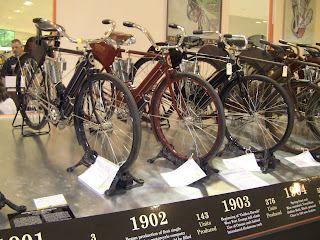
  One more thing to add to your "bucket-list", Motorcyclepedia motorcycle museum opens in Newburgh, New York.


  Gerald A. Doering bought his first bike, a 1929 Indian Scout in 1947.  Hoping to get a job at a motorcycle dealership that moved from Newburgh, New York to Florida,  Doering rode his 1929 Indian to Florida.  When the job didn’t pan out, he rode that same Indian back to Newburgh.


  Gerald Doering than began to collect Indian motorcycles, and over the years, collected Indians from every year of their manufacture, 1901-1953.  His passion for collecting motorcycles was shared with his son, Ted, and in 1971, the father and son team started an after-market motorcycle parts business, V-Twin Manufacturing, in New Windsor, New York.  The success of the company made it possible for the father and son to expand their motorcycle and memorabilia collection and in 2010, Ted began putting together what is now an 85,000 sq. ft. museum in Newburgh.


  Their collection now spans well over 400 motorcycles, ranging from Indians, Harleys, Military and Police models, choppers, vintage hill-climbers, classic British and Japanese bikes, and from America's glory days of motorcycle manufacturing, machines such as Thor, Cleveland, Flying Merkel, Pierce and Reading Standard, to name but a few.


   The museum’s Indian Room features the world’s most complete Indian Timeline.

Monday, April 14, 2014

Today in motorcycle history, April 14, 1938


  The new BSA 249cc "with coil ignition" is road-tested and reviewed in the British newspaper, The Motor Cycle, issue #1,827, Volume 60, April 14th, 1938.


 The final verdict on the 249cc?  "The new BSA is a simple yet lively lightweight, well made and endowed with an unusual range of performance."

  If you're lucky enough to find a copy (Ebay? Grampa's locked and stowed away trunk?) it also covers the Ariel 250cc single-cylinder and it's 1000cc four-cylinder big brother, "each an example of the most advanced engineering practice." 


  The paper claims that it " covers every phase of the movement and circulates throughout the world".


   England was home to over 80 different makes of motorcycles in the 1930's.


  The first instance of the term "motor cycle" appeared in English in 1894 used in materials promoting machines developed by E.J. Pennington, although Pennington's motorcycles never made it past the prototype stage.


   Excelsior Motor Company started life as a bicycle manufacturing company based in Coventry, England.  They began production of their first motorcycle model in 1896, available for purchase by the public.  The first production motorcycle in the States was the Orient-Aster, built by Charles Metz in 1898 at his factory in Waltham, Massachusetts.

Friday, April 11, 2014

Today in motorcycle history, April 11, 1980


  The Uniondale Ghost strikes again.


  In my painstaking efforts to keep you informed on what happened today in motorcycle history I came across this newspaper article from the "Daily Breeze" (seriously, that's the papers name) in Torrance, California, dated Friday, April 11, 1980. 


  The motorcycle ghost of the Karoo Desert has struck again. The ghost, said to be a woman who died in a motorcycle accident more than 10 years ago near Uniondale, badly frightened Andre Coetzee, 20, who was breezing along the highway on Good Friday.

 
  "I was riding near the Baramdas turnoff (the site of the fatal accident a decade ago) when I felt my hair stand on end inside my crash helmet and someone or something put its arms around my waist from behind. There was something sitting on my bike," the Skaen Coetzee said.
 
  The frightened motorcyclist said he accelerated to 80 mph to get away, but the ghost hit him three times in the helmet to get him to slow down. "The blows were vicious,' he said. When he reached 100 mph, Coetzee said, 'the apparition disappeared."  Coetzee drove to a local cafe for help.
 
  "He could hardly speak when we asked him what had happened. But gradually it dawned on us that the woman ghost had appeared once more," said Jeanetta Meyer, the cafe owner.


  There have been several reports in recent years of motorcyclists picking up a blonde woman hitchhiker near Uniondale, only to find that she had vanished from the back seat after a few miles.


  In case you're curious (and who isn't?), Uniondale is a small town in the Little Karoo semi-desert region of the Western Cape Province of South Africa. 

  According to the local media, in stormy weather on Easter weekend of 1968 a young engaged couple had a car accident on the Barandas-Willowmore road (N9) around 10 miles outside of town. The woman, Marie Charlotte Roux, was sleeping in the back seat of their Volkswagen Beetle when her fiancĂ© lost control of the car. The car overturned and she was killed.

  The first reported sighting of a female hitchiking ghost occurred during the Easter weekend of 1973 and since then, on the anniversary of the accident, a butt-load of sightings have been reported. Oddly, they all involve a female hitchhiker who is given a lift and then... 


  If you're looking to buy some new music there is a song available out there called "Bloometjie Gedenk aan My (Oh, My Flower, Remember Me)" by Anton Goosen. 

 
  Hey, Rick, is it any good?  All I can say is it did make the list, "1001 South African Songs You Must Hear Before You Die".  You listen, you decide.


Wednesday, April 9, 2014

Today in motorcycle history, April 9, 1989


  Homeboy Wayne Gardner wins the Australian Grand Prix at Phillip Island.


  The 1989 Australian motorcycle Grand Prix was the second leg of the 1989 Grand Prix motorcycle racing season and was the first ever World Championship Motorcycle Grand Prix to take place in Australia.

  With the crowd behind him Wayne Gardner (Honda) outraced American Wayne Rainey and the Frenchman, Christian Sarron, both aboard Yamaha's.

   After the race a whiney Rainey said, “Gardner ran into the back of me twice, and didn’t even notice. He was one of the sloppiest guys I ever raced – he reminded me of a bulldog on a bike. When he was on a good day, he could ride that thing right out of the saddle. He was a bit like Kevin, but more out of control. Not a thinking racer: he rode by the excitement of the crowd. If nobody was there I think he wouldn’t do much.”


    Nobody likes a crybaby.

Tuesday, April 8, 2014

Today in motorcycle history, April 8, 1951


  With a white-knuckle grip on his throttle, Great Britain's Tommy Wood wins the 1951 Spanish Grand Prix 350cc class for the second year in a row.  He earned both of those checkered flags while riding the 'Birmingham Beauty', a 1949 Velocette KTT MK8.


  The Spanish GP was the first round of the 1951 Grand Prix motorcycle racing season.  It took place at the MontjuĂŻc circuit located on the MontjuĂŻc mountain in Barcelona, Catalonia, Spain.


  Tommy Wood would shift over to Moto Guzzi to win the 1951 Isle of Man Lightweight TT.  The Isle of Man would be the last race he would ever win.


Monday, April 7, 2014

Today in motorcycle history, April 7, 1972


  The Yankee Motor Company holds an open house for Dick and Judy Workingmann to come and see the new Yankee Z.


  The Yankee was conceived near the Hudson River, in the gritty General Electric town of Schenectady, New York.  In the late 1960's, John Taylor’s Yankee Motor Company was importing Ossa 230cc motocross and enduro bikes.  The Daytona 200 legend Dick Mann was competing, and winning, with these in quarter-mile flat-track races.  His success on board Yankee’s imported Ossa's led to the development of a 250cc Ossa-powered “Dick Mann Replica,” or DMR, which featured a frame completely manufactured in Yankee’s Schenectady facility.  The DMR would provide the test bed for the Yankee Z.


  The concept for the engine had been designed by Eduardo GirĂł of the Ossa factory in Barcelona, Spain. The Z’s heart was the most notable of its myriad of fascinating features. The engine was essentially two Spanish Ossa 230cc two-stroke singles melded together.  By using the internals and mating them with a splined crankshaft the engine could be made to fire with both pistons together, as a large single cylinder engine would and, with a relatively easy method, be made to fire with each piston taking its turn at the top of the stroke, (as most twin-cylinder engines of the time did), turning the bike into one torquey twin with a common crank and cases. 


  Originally, it began with the 230cc. engine cylinders, pistons, and crankshafts, but by the time the motorcycles were actually produced, the Ossa became a 250cc, and therefore, the Yankee became a full-fledged 500cc twin.


   The Yankee was the first production motorcycle to have a rear disk brake system.  The Yankee had a 6-speed tranny with the option to lock out low gear so it would comply with the AMA racing rules of the time.  It had stainless steel handlebars and a strong, light frame which was made from chrome-moly tubing with the oval swingarm being totally new to motorcycling.  The forged aluminum fork crowns were produced by the gun-making Smith and Wesson Company of Springfield, Massachusetts.  A quick-release seat and large air filter system was a big plus for the serious dirt ridin' freaks.


  Delays in production were eventually the Yankee's downfall, as lighter, more reliable motorcycles made their way into the American market.  Sadly, by the time the first Yankees rolled off the assembly line in 1971, the weight differences were large enough to make the serious enduro rider shy from owning the Yankee.