Wednesday, September 24, 2014

Today in motorcycle history, September 24, 1972


At Cadwell Park the 750cc British champion, Dave Potter, riding a Gus Kuhn Norton, needed to be in top form to win a hard-fought 750cc race from two-time Northwest 200 champion Derek Chatterton.


  A Yorkshireman from Hovingham, Dave Potter moved south after only his first road race. A friend went to work for Paul Dunstall and told him there was another job available. Dave up and quit his job as a car mechanic, broke his Gold Star into bits, packed it into the back of his car and headed for London.


  Potter started his road racing career riding his beloved BSA Gold Star in 1969. Within three years he was crowned the 1972 750cc Class British Champion riding a Gus Kuhn-Norton. He raced for Vincent Davey and Willie Ryan before filling the gap with Ted Broad left by Barry Ditchburn who had won a Kawasaki works contract. Potter was second in 1978 and won the British Superbike Championship twice in a row in 1979 and 1980, riding a Yamaha for team Mitsui.  


  Tragically, Dave Potter died at Oulton Park on August 31, 1981. On the last lap of the second heat of the event, he lost control while approaching the Cascades bend and crashed into a guard-rail at 95 mph.  He had been racing for Ted Broad for six years and the death of one of racing's most-loved riders was such a blow that Ted withdrew from the sport.


  Today in motorcycle history proudly supports the National Association for Bikers with a Disability (NABD)  www.nabd.org.uk

Monday, September 22, 2014

Today in motorcycle history, September 23, 1972


   The Yamaha factory wins its first-ever 500cc Grand Prix race when Chas Mortimer rides to victory in the Spanish Grand Prix held at Montjuïc Circuit in Barcelona, Catalonia, Spain. The Spanish Grand Prix marks the end of the 1972 GP season which began on April 30 with the West German Grand Prix.


  Mick Grant, seven-time winner of the Isle of Man TT, finishes the 1972 GP season ranked 17th. 


  Mick began his racing career as a privateer, entering his first Manx Grand Prix in 1969 on a 500cc Velocette, and his first TT in the following year, again using the Velocette and placing 18th in the Junior Class on a Lee-sponsored Yamaha.
  Showing great poise and the ability to twist the throttle at the right time Grant quickly became a works Norton rider alongside Peter Williams and Phil Read.  In 1972, he teamed with Dave Croxford to win the Thruxton 500 endurance race on a 745cc Norton Commando, and finished second to Williams in the 1973 F750 TT.

  In 1975, it was Mick Grant who finally broke Mike Hailwood's Isle of Man TT lap record, which had stood since 1967, raising the average-speed of one lap to 109.82 mph on a Kawasaki two-stroke triple entered by the Boyer of Bromley team headed by the legendary motor-man, Stan Shenton.


  Today in motorcycle history proudly supports the National Association for Bikers with a Disability (NABD).  www.nabd.org.uk

Today in motorcycle history, September 22, 1949


  The September 22, 1949 issue of "The Motor Cycle" covers the 1949 24th International Six Day Trials (ISDT) in the wet and rocky Welsh countryside.


  Page after page of pics of Champion riders like Jim Alves, Fred Rist, Murray Walker, Ted Usher, Johnny Brittain and Tommy McDermott on classic marques like BSA, James, Sunbeam, Rudge and Matchless. Scaling the old slate quarry Blaen y Cwm, ridng to the summit of Bwlch y Groes (aka Hellfire Pass), breaking an ankle on the rocks at Waen y Gadfa or trying to keep it straight crossing Abergwesyn Splash. All this for just a shilling.


  Today in motorcycle history proudly supports the National Association for Bikers with a Disability (NABD).  www.nabd.org.uk

Friday, September 19, 2014

Today in motorcycle history, September 19, 1985


.


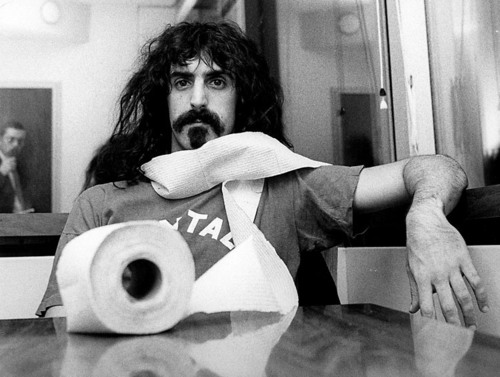
  1985 – Tipper Gore of the Parents Music Resource Center (PMRC) casts an evil eye on Frank Zappa as he testifies at the U.S. Congressional hearings on obscenity in rock music.


  A long-time fan of motorcycles, the avante garde and an eventual friend to bikers worldwide, Frank Zappa's first fascination with two-wheels was in high school when his brother, Bobby, introduced him to Jim "Motorhead" Sherwood in 1956.  A future room-mate and Mother of Invention bandmate, Sherwood was always turning a wrench on someone's bike or car, hence the nickname "Motorhead".  His greasy-fingered influence on Zappa turned up repeatedly in references to motorcycles on record or on stage.


  A line from Bwana Dik: "My dick is a Harley, you kick it to start".


  In "Titties & Beer" the 'motorcycle man' is Frank Zappa's role in performances:

   "...I'm mean 'n I'm bad, y'know I ain't no sissy/Got a big-titty girly by the name of chrissy/Talkin' about her 'n my bike 'n me...


   ...blow it out your ass, motorcycle man! I mean, I am the devil,do you understand?


  "The Adventures Of Greggery Peccary" the lyrics go, "... They zoom after him in all manner of cars, trucks, garishly-painted buses, and motorcycles..."


  Motorcycle boots are mentioned in the Freak Out! sleeve notes.  Freak Out! Hot Spots, item #16 - "Stripcombers is HAPPENING for black leather jackets and motorcycle boots..."


  And who could forget the classic biker film, "Naked Angels" with it's great promotional tag line, "Mad dogs from hell hunting down their prey with a quarter-ton of hot steel between their legs."

  The film’s soundtrack was co-written by Jeff Simmons who would eventually to become a member of the Mothers of Invention and was originally released in 1969 on Frank Zappa’s “Straight Records” label.


  Back to Tipper and Frank...

  From 'The Harvard Crimson' - "Offbeat rock musician Frank Zappa last night attacked a parents group which is fighting obscenity in popular music.


  Before more than 500 at the Kennedy School of Government, Zappa spoke out against the recent agreement between the Record Industry Association of America and an influential parents group to label offensive records with warning stickers or to print the lyrics on the album jacket.


  He called the parents movement a "hysteria campaign," and said that record companies, not the parents group, would determine what is obscene. Zappa said the labels would not prevent anyone from buying the records.


  Parents' Music Resource Center (PMRC), argued that listening to obscene lyrics can be "extremely damaging to adolescents in the formative years," because many teenagers view rock musicians as role models. She also said that "parents need a tool" in determining what their children should and should not listen to.


  Under the terms of the compromise with the PMRC, which includes several Congressional wives, one-half of the record industry's 44 companies agreed to either place a parental advisory warning label on records with lyrics describing "explicit sex, violence, or substance abuse" or to print the lyrics on the album jacket."


   Listen to what you like, ride what you like. It's your life.


   Today in motorcycle history proudly supports the National Association for Bikers with a Disability (NABD). www.nabd.org.uk


Thursday, September 18, 2014

Today in motorcycle history, September 18, 1979


  Greg Arama, bassist for The Amboy Dukes, is killed when he crashes his 1976 Harley-Davidson.


  Greg Arama was the mastermind behind the great bass line in the Amboy Dukes song "Journey to the Center of the Mind",  a #16 hit on the Billboard charts in 1968. 

  After the Amboy Dukes, Arama formed Ursa Major with fellow Detroit-area guitarist Dick Wagner (Lou Reed, Alice Cooper).  Ursa Major released one album in 1972, simply titled: "Ursa Major."  


  Sadly, Greg Arama was killed in California after losing control of his 1976 Harley-Davidson XLCH Sportster.


  Today in motorcycle history proudly supports the National Association for Bikers with a Disability (NABD).  www.nabd.org.uk.

Tuesday, September 16, 2014

Today in motorcycle history, September 17, 1940


  Italian Grand Prix motorcycle racer, Gilberto Parlotti is born in Zero Branco, Treviso, Italy.


  After winning the first two races of the 1972 Grand Prix season in West Germany and France, Gilberto Parlotti was leading the 125cc World Championship riding a works Morbidelli and decided to race at the Isle of Man TT to take advantage of his main rival Angel Nieto's absence from the Mountain Course. Tragically, he was killed on the second lap of the race when he crashed in the pouring rain at the Verandah section on the A18 Mountain Road.


  Parolotti's death helped bring about the end of the Isle of Man TT Races as a World Championship event.  His close friend Giacomo Agostini, overcome with grief, declared that he would never race on the Island again and was supported by the MV Agusta factory.  Agostini considered it too unsafe to be a part of the FIM World Motorcycle Championship calendar.  At the time, the Isle of Man TT was the most prestigious race on the World Championship calendar.  Other top riders soon joined his boycott of the event and by 1976, the event was dropped from the Grand Prix championship schedule. 


  Today in motorcycle history proudly supports the National Association for Bikers with a Disability (NABD).  www.nabd.org.uk

Today in motorcycle history, September 16, 1961


  Hurricane Debbie destroys Alan Gleeson's 1951 350cc Royal Enfield Bullet (and the garage it was in).


  Hurricane Debbie made landfall in Dooega on Achill Island during the morning of September 16.  Shortly thereafter, it had moved into the Irish mainland over County Mayo. When Debbie struck Ireland, it became the only known tropical cyclone to do so while still tropical.  She brought with her record winds, a few locations reporting excess of 100 mph, including at Balleykelly, Tiree and Snaefell.  A peak gust of 114 mph measured just offshore. These winds caused widespread damage and disruption, downing tens of thousands of trees and power lines. Countless structures (including garages and pubs) sustained damage or were destroyed.


  Across Ireland Hurricane Debbie was responsible for the deaths of 18 people, 12 in the Republic of Ireland and six in Northern Ireland.  It caused $40–50 million in damage in the Republic and at least $4 million in Northern Ireland.


  Alan Gleeson had bought his Bullet after Johnny Brittain won a gold medal on his 350cc in the 1950 International Six Days Trial (ISDT) in Wales.


  Today in motorcycle history proudly supports the National Association for Bikers with a Disability (NABD).  www.nabd.org.uk